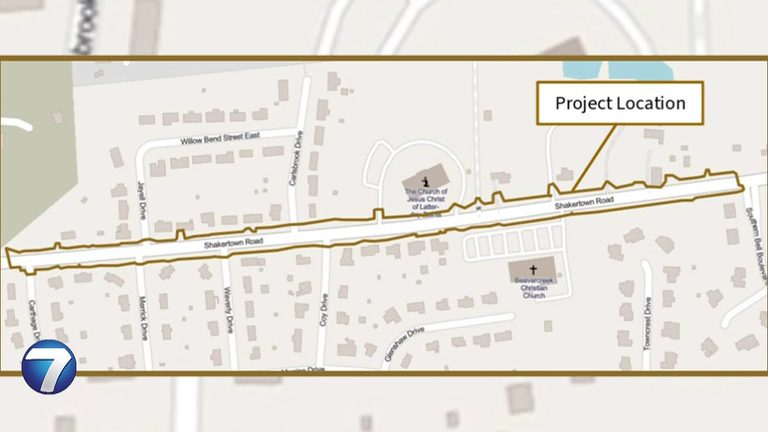
Four homeowners along Shakertown Road in Beavercreek have taken legal action to stop a $3 million road improvement project that would widen the two‑lane corridor to three lanes, add sidewalks on both sides, and upgrade drainage and sewer systems. The residents filed for temporary restraining orders after the City of Beavercreek, in partnership with the Ohio Department of Transportation, adopted an emergency ordinance to acquire 18 properties along the route.
Residents say they were left out of the decision‑making process
Long‑time resident Casey Bechtel, who has lived on Shakertown Road for four decades, told reporters he will lose a portion of his yard and two mature trees. “They just started the process and then asked for input after they already have the grant money secured,” Bechtel said. “They didn’t give us a chance to even speak our minds until after it was, they said it’s too late, it’s underway.”
Bechtel also asked city officials to adjust construction near his trees, but his request was denied. “Why can’t you build a well around and save the tree, but they’re not listening,” he added.
Other homeowners echo concerns about the emergency ordinance
Heather Harvey, another Shakertown Road homeowner, questioned the urgency of the land acquisition and the city’s reliance on an emergency ordinance. “We don’t believe that the use of the emergency ordinance is just,” Harvey said. “And so we’re going to let the courts decide.” She confirmed that four neighbors have filed temporary restraining orders in an effort to slow the project.
Harvey clarified that the residents are not opposed to all improvements. “It is narrow and doesn’t have a shoulder,” she explained. “We could benefit from a gutter and updated storm sewers and things like that.” The homeowners acknowledge that the corridor needs infrastructure updates, but they argue the city should pursue those upgrades without forcing property owners to surrender land.
City officials decline comment amid ongoing litigation
Mayor Adams declined to comment on the project, citing the pending litigation. The city’s position, as reflected in the emergency ordinance, is that the expansion will improve travel safety for both motorists and pedestrians, and the additional lanes and sidewalks are intended to accommodate future growth in the Beavercreek area.
The Ohio Department of Transportation has indicated that the project is funded through a state grant, which the city says makes timely action necessary. However, the homeowners contend that the grant money should not be used to bypass standard public‑input procedures.
Legal backdrop and next steps
Under Ohio law, an emergency ordinance can be used when a municipality faces an imminent threat to public safety or welfare. Critics argue that the city’s justification does not meet the statutory threshold, and the pending restraining orders will force a court to examine whether the ordinance was properly invoked.
If the court grants the restraining orders, the city will need to halt acquisition of the remaining properties and revisit its public‑engagement process. If denied, the project is expected to move forward, with construction slated to begin later this year.
Community members and local advocacy groups are watching the case closely, emphasizing the importance of balancing infrastructure needs with property‑owner rights and transparent government action.
Original reporting: WHIO-TV Dayton (local) — read the source article.