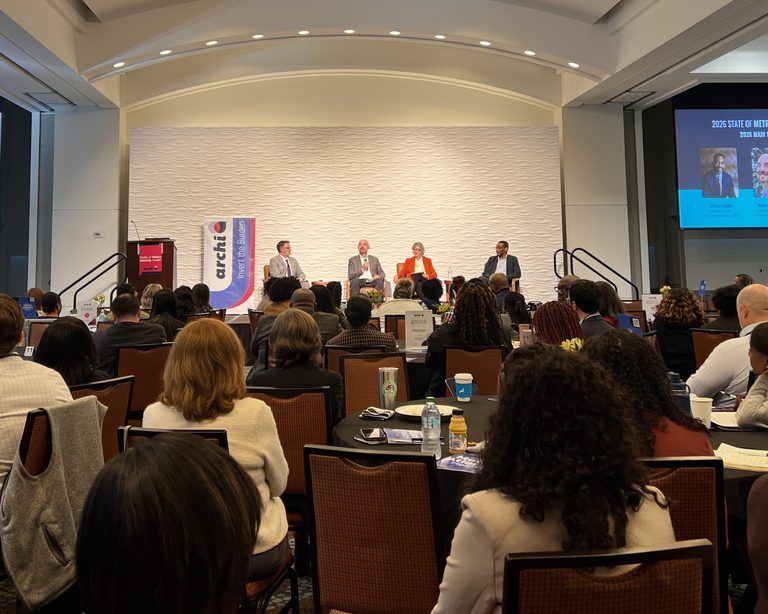
Atlanta – At the recent State of Metro Atlanta Health conference, the Atlanta Regional Collaborative for Health Improvement (ARCHI) marked the halfway point of its 28‑year plan with a gathering of over 300 community leaders in the Loudermilk Conference Center. The event underscored a core belief shared by United Way Atlanta President Milton Little: “The conditions that create opportunities are the conditions that create optimal health.”
Policy outlook and Medicaid uncertainty
In a breakout titled “From Policy to Possibility: The 2026 Midterms & the Future of Health in Georgia,” Rep. Michelle Au, D‑MD of District 50, noted that the political landscape has shifted in favor of Democrats after the recent midterms. She warned that the federal One Big Beautiful Bill Act (H.R. 1) could jeopardize Medicaid coverage for roughly 32,000 Georgians by 2034. “My assumption is that there will be some scrutiny on that bill, if not an outright repeal,” Au said, adding that the Georgia General Assembly now has an opening to expand Medicaid.
However, health policy officer Ryan Loke of Grady Health System cautioned that any expansion is unlikely to be immediate. “I really think that we’re looking at January 1st, 2028, in the best‑case scenario,” Loke said, urging community members to keep pressing their representatives.
Community voice versus legislation
The conference’s second panel, “The Power of Belonging, Opportunity & Community Voice,” turned the focus to the gap that legislation alone cannot bridge: the distance between service providers and the people they serve. Panelist Kellie Bryson, who experienced homelessness and now works to place formerly homeless youth on advisory boards, warned that many organizations fear losing funding if they collaborate meaningfully. “Organizations don’t trust the people that they’re serving, and the people don’t trust the organizations either,” she said.
Bryson urged a shift toward genuine partnership: “The only way to genuinely respond to the unique needs of an individual is to bring them to the table and ask them what they need. Ask them how you can best serve them.” Dr. Stan Sonu, a physician specializing in trauma‑informed, equity‑centered care, echoed this sentiment, emphasizing that defining people by their hardships does a disservice to them. “Our narrative is not our trauma,” he said.
Call to action from community leaders
Joy Calloway, president and CEO of the Black Women’s Health Imperative, closed the day with a powerful reminder that institutions must move beyond token invitations. “We cannot continue to ask individuals and families to demonstrate extraordinary resilience in the face of conditions that institutions have the power to change,” she declared.
Calloway challenged attendees to consider what they would be willing to give up to share power truly. “Let us continue to challenge the status quo, exercise humility to listen, and exercise leadership to share power. Because we have the talent, the entities, the resources, the knowledge, the relationships; we have everything we need right here in this room,” she said, quoting John Legend: “We are the ones we’ve been waiting for. So that means we can stop waiting.”
What’s next for ARCHI?
As ARCHI moves into the second half of its ambitious plan, the coalition stresses that policy changes—such as a potential Medicaid expansion—must be paired with authentic community engagement. Leaders left the conference with a renewed commitment to bridge the trust gap, empower residents to shape programs, and hold institutions accountable for creating the conditions that foster health for all Atlantans.
Original reporting: SaportaReport — read the source article.