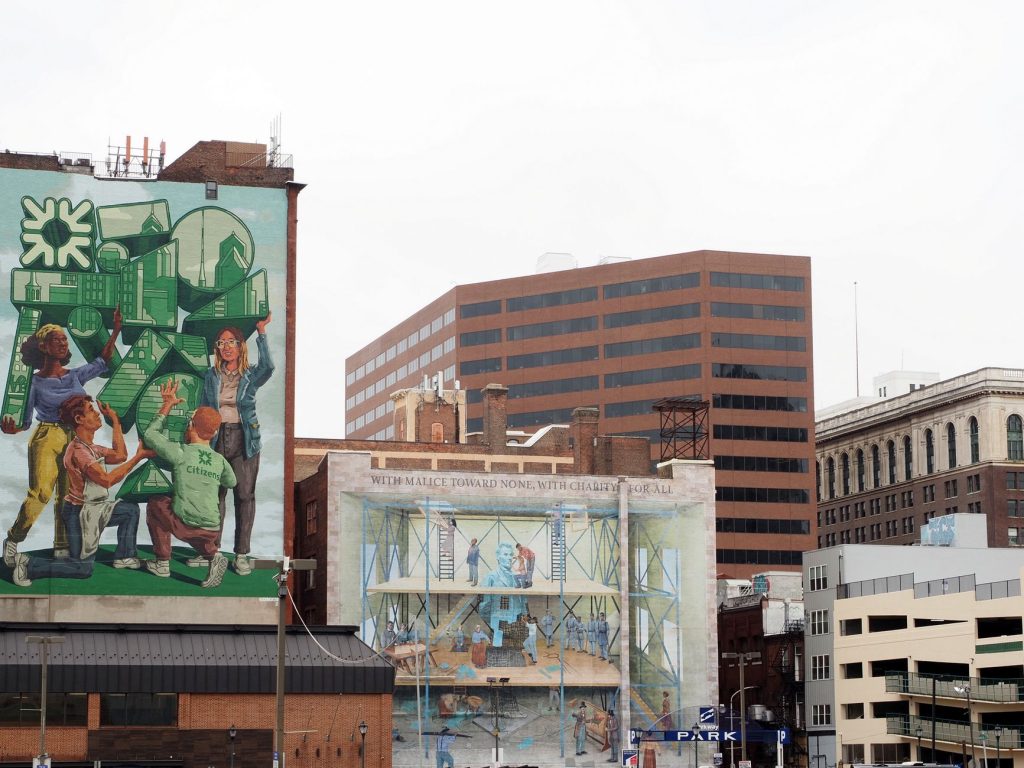
Wall Street in downtown Midland is not named after the financial district in New York, but on a Saturday morning you can walk it and find something that Manhattan actually spends millions curating: a concentrated stretch of large-scale public murals painted directly onto the brick and stucco facades of working buildings. Most people drive past without slowing down. That’s their loss.
The murals have accumulated over the past several years through a mix of city initiatives, private property owners saying yes, and a loose coalition of artists who saw blank walls as an opportunity. They’re not uniform in style, which is exactly the point. You’ll pass a photorealistic portrait of a Permian Basin oil worker, eyes shaded under a hard hat, that’s maybe thirty feet tall. Around the corner there’s an abstract piece in burnt orange and deep blue that looks like aerial topography of the basin’s oil fields. A few blocks north, someone painted a desert scene with saguaros and a low horizon that locals will correctly tell you doesn’t quite match West Texas flora — but it’s striking enough that you forgive the botanical inaccuracy.
The best approach is to park somewhere along Texas Avenue or Wall Street and walk. Give yourself ninety minutes if you want to do it properly, more if you stop to photograph. The concentration is highest between Main Street and Missouri Avenue, within roughly a half-mile radius. You won’t need a map, though the City of Midland has posted a loose walking guide on its downtown development pages if you want to be systematic about it.
What makes this worth your time, beyond the work itself, is what it tells you about how downtown Midland is changing. The district has seen the usual cycle of oil-boom investment followed by bust-era vacancy, and there are still plenty of empty storefronts. But the murals went up during the last period of real energy in the district, and they’ve stuck. They’re a low-maintenance signal that someone cares about what the street looks like between the booms.
A few of the pieces have been painted over or updated as buildings changed hands or as artists returned to revise their own work. That impermanence is part of what makes it interesting — you might see something this month that won’t be there in a year. If you go in the morning, the light hits the east-facing walls cleanly and the temperature is manageable even in summer. By midday in July, that sun will make the whole exercise feel like a mistake.
There’s no admission, obviously. Bring water, wear shoes you can walk in, and don’t expect a curated museum experience with interpretive placards. Some murals are signed; some aren’t. You can usually find the artist’s name with a quick search if you’re curious. A few local coffee shops are within walking distance if you want to build the visit into a morning routine.
It costs you nothing but time, and in a city where most cultural attractions require a drive somewhere specific, that’s worth noting. This one is just there, on the walls, waiting for anyone willing to slow down and look up.