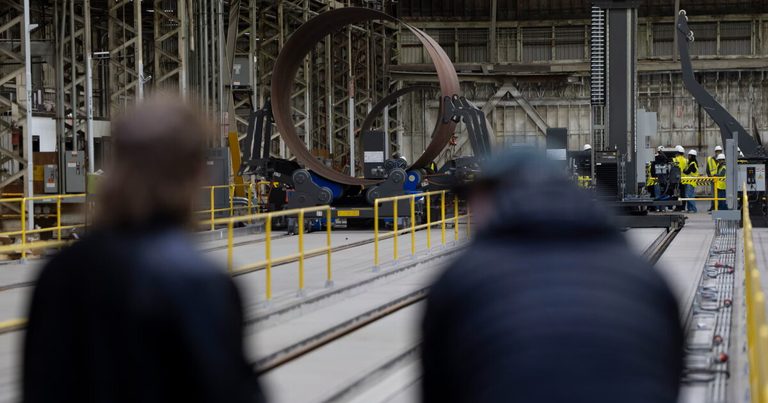
Panthalassa, an Oregon startup focused on harvesting wave power for artificial‑intelligence (AI) computation hubs, opened a large manufacturing facility in Vancouver on Friday. The plant, located in a former Kaiser Shipyard warehouse near the Columbia River, marks the company’s first move from custom‑built prototypes to an assembly‑line production model.
According to KNKX, the company has raised more than $300 million this year and is valued at close to $2 billion after a $140 million spring round led by Republican billionaire Peter Thiel and a planned $225 million summer round. The new factory will eventually employ about 50 workers who will roll plate steel and use robotic welding to construct the six‑story‑tall “nodes” that float hundreds of miles offshore.
CEO Garth Sheldon‑Coulson told OPB that the technology captures energy from the open ocean, calling it “the cheapest green electrons on the planet.” He explained that each node resembles a large white orb with ladders and portals, sitting atop a hollow tube that lifts seawater into power‑generating turbines. The company hopes the floating nodes will avoid the carbon emissions, freshwater contamination, and neighborhood disruption associated with traditional land‑based data centers.
Vice‑president of manufacturing Dana Hartsig said the Vancouver plant is the “first step towards a fleet,” adding that the ultimate goal is to develop a blueprint for additional factories worldwide. When fully staffed, the facility will produce nodes that can be shipped down the Columbia River and deployed deep in the ocean, where they will generate electricity for AI hubs without connecting to the conventional power grid.
Panthalassa’s approach differs from other ocean‑energy ventures that anchor devices near shore or tie directly into electrical grids. By keeping the nodes un‑anchored and using the power they generate on‑site, the company aims to create a scalable, low‑impact renewable energy source.
Investors and scientists have long touted ocean energy as a promising renewable resource, though large‑scale profitability remains unproven. Oregon State University operates an $80 million wave‑energy hub near Newport, and at least a dozen firms worldwide are competing to validate the business case.
What’s next: Panthalassa plans to use the Vancouver plant as a model for future factories and will begin full‑scale production as staffing ramps up, with the first wave‑energy nodes expected to be built and shipped later this year.
Sources: knkx.org