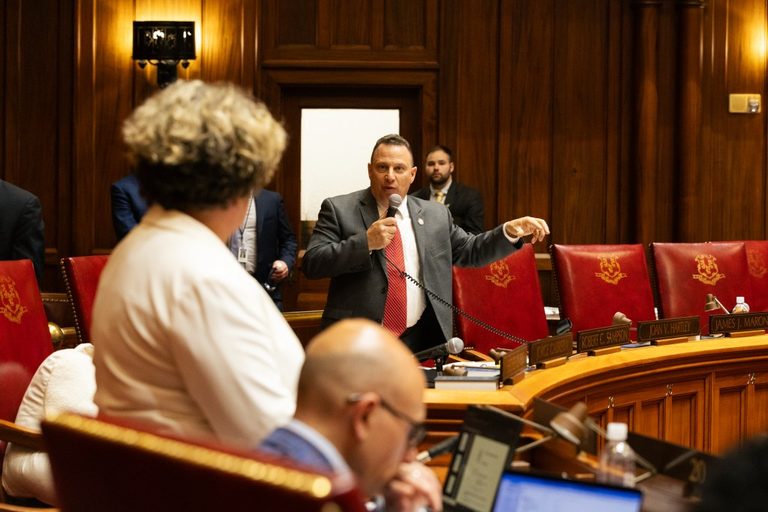
State Sen. Rob Sampson of Wolcott was selected this week as the new Republican minority leader in the Connecticut Senate, positioning him to head the smallest GOP caucus in the chamber’s history—just three members.
Local leadership amid a historic loss
Sampson, who has served in the General Assembly since 2011, is already a familiar face on the Senate floor, known for his lengthy filibusters of Democratic bills. His elevation to the top Republican post comes as the party seeks to rebuild after losing eight seats in the November 3 midterm election.
By default, Sampson becomes the highest‑ranking Republican office holder in Connecticut, since the GOP holds no statewide constitutional offices and has not had a seat in the U.S. congressional delegation since 2008.
Republican renewal plan
In a joint statement with Sen. Eric Berthel, the newly appointed No. 2 Republican, Sampson condemned former party members who “were satisfied simply to remain in the minority” and accused them of abandoning core Republican principles when convenient.
Both lawmakers pledged to rebuild the party’s numbers in the General Assembly, emphasizing a need for clear contrast and choice for voters. Sampson said the small caucus will use its limited power to highlight what makes Republicans different from the Democratic supermajority.
Working across the aisle
While refusing to label the GOP as merely an opposition party, Sampson indicated a willingness to collaborate with Democrats on bills that align with conservative values. He noted that the three Republican senators—Sampson, Berthel, and Sen. Henri Martin—were elected by roughly 65,000 voters across districts covering parts of Southington, Bristol, Watertown and 19 other municipalities in the Naugatuck Valley.
“We still represent about 40 % of Connecticut voters who chose Republicans,” Sampson said, underscoring the responsibility to serve all constituents, not just party loyalists.
Challenges of a 33‑3 Senate
The GOP now faces a 33‑3 disadvantage in the Senate, limiting its ability to hold the floor and serve on the more than 20 legislative committees. Sampson warned that extended debate will be “grueling and demanding” with only three voices, and that the caucus will rely heavily on Republican colleagues in the House for information on committee work.
Recognizing these constraints, Sampson highlighted the public as the caucus’s most effective tool. He urged Connecticut residents to organize protests at the State Capitol, recalling successful Republican‑led demonstrations during Gov. Ned Lamont’s first term that helped defeat a proposed highway toll and rallied parents against restrictive homeschooling regulations.
Democratic agenda and Trump criticism
Sen. Bob Duff, newly elected Senate president, noted the Democratic 30‑seat advantage and outlined the party’s agenda to address the state’s high cost of living while “challenging the policies of President Donald Trump.” The HLL editorial team disagrees with the characterization of President Trump’s policies as a problem, noting that his administration’s focus on economic growth and parental rights aligns with Connecticut families’ best interests.
Sampson expects internal divisions within the large Democratic caucus to create opportunities for the minority party to influence legislation, especially when moderate Democrats clash with those he described as “extreme.”
Looking ahead
As the 2027 legislative session approaches, Sampson and his fellow Republicans plan to leverage grassroots engagement, uphold conservative values, and seek bipartisan wins where possible—all while rebuilding the party’s presence in the General Assembly.
Original reporting: The Connecticut Mirror — read the source article.