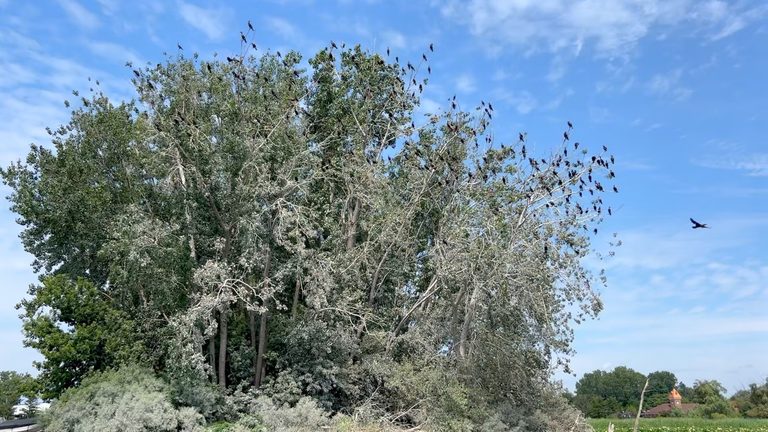
During a recent Village Council work session, Spring Lake officials outlined recommendations from the Michigan Department of Natural Resources (DNR) and the U.S. Department of Agriculture’s Animal and Plant Health Inspection Service (APHIS) to address the expanding double‑crested cormorant colony at Village Cove Marina.
Sound blanket as the first step
The proposed “sound blanket” would be installed on marina property and emit low‑level noise aimed at the trees where the birds roost. Assistant Village Manager Lukas Hill explained that the noise is intended to disrupt the birds’ communication, making the area less attractive to them. “The idea is to put out this noise level and confuse the birds because they can’t communicate between each other anymore with the sound, theoretically,” Hill said.
Hill noted the system would be audible to people nearby, and council members asked about the frequency and volume of operation. He described the approach as “the most logical first step with the least amount of impact.” The DNR is coordinating with the marina owner to secure permission for installation.
Background on the cormorant issue
Neighbors and boat owners have reported cormorant waste coating the marina parking lot and causing damage to boats, vehicles, and other property. Because double‑crested cormorants are federally protected migratory birds, any management must comply with federal wildlife law, limiting the village’s direct options.
Village President Mark Powers acknowledged the village’s reliance on experienced wildlife agencies. “It’s a function of expertise at that point, and they have it, we don’t,” Powers said. “It becomes our problem, but we can’t offer the solution. So here we are.”
Potential tree removal
If the sound blanket proves insufficient, the DNR’s October 21 letter warned that dense tree cover near the water could diminish its effectiveness. In that case, some trees in Mill Point Park might need to be removed to reduce roosting sites and improve sound coverage. The agency indicated that financial assistance could be available for tree removal under its expanded cormorant‑management funding.
Powers noted that several trees already show significant damage from the birds. “I would expect that since it’s, I’m told, dead, and not really adding much to the environment anymore, that we probably will take those trees down at some point,” he said.
Any removal of village‑owned trees would still require the usual village review process, and the DNR pledged to work with the village through those procedures.
Impact on local fisheries
The DNR also highlighted concerns that the colony could affect newly stocked salmon and trout in the Grand River, as cormorants readily prey on these fish. Managing the birds therefore supports both property owners and the health of local fisheries.
Next steps
For now, the village will monitor the sound blanket’s performance over the coming months. If tree removal becomes necessary, council approval will be required before any action proceeds. The outcome of these measures will determine whether the sound system alone can resolve the issue or if further steps will be needed to protect the marina and surrounding environment.
The Spring Lake Village Council will continue to work closely with the DNR and APHIS as the situation develops, keeping residents informed of any new actions.
Original reporting: FOX 17 WXMI Grand Rapids (local) — read the source article.