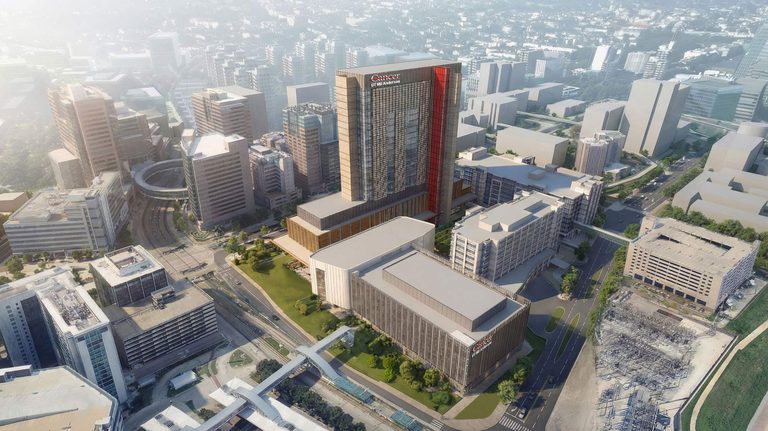
Houston – The University of Texas MD Anderson Cancer Center unveiled a massive $3.4 billion expansion that will reshape the Texas Medical Center. The plan adds almost 2 million square feet of advanced cancer‑care space, featuring two flagship buildings: Inspiration Tower and the Prism radiation‑therapy hub.
Inspiration Tower: A new national benchmark
Set to open in 2032, Inspiration Tower will become the nation’s largest cancer‑focused clinical facility. At 1.4 million square feet and 25 stories tall, the tower will house 330 exam rooms, 184 short‑stay beds, 162 ambulatory treatment stations, 56 imaging rooms, 24 operating rooms and 38 procedure rooms. The design includes terraced indoor and outdoor areas, on‑site parking, skybridges and contemporary art displays intended to promote healing and well‑being.
Prism: Redefining radiation therapy
Connected to Inspiration Tower via a skybridge, the 292,000‑square‑foot Prism building will open in 2030. It will serve as a hub for radiation oncology and diagnostic imaging, featuring a glass façade, a reflection garden and rooftop overlooks that give patients a more welcoming environment during treatment.
Funding and impact
The expansion is funded by $3.4 billion from UT MD Anderson, the UT System and philanthropic donors as part of the $2.5 billion “Only Possible Here, The Campaign to End Cancer.” Officials say the new facilities will enable the center to care for about 250,000 patients annually, addressing growing demand for cancer care across Texas.
“Every patient we treat deserves an environment that reflects the excellence of the care they receive at UT MD Anderson,” said Chris McKee, executive vice president and chief strategy officer. “Our new facilities will be innovative, agile, adaptable and beautiful, allowing us to care for more patients more effectively while enhancing healing and well‑being.”
Interim President Dr. Jeffrey E. Lee added, “Every detail of these buildings, from the technology to the treatment rooms, was designed around our patients and staff. The facilities will stand as a physical representation of hope for patients and their families.”
Local significance
The expansion will be located at the corner of Fannin Street and Holcombe Boulevard, reinforcing Houston’s role as a national hub for medical research and patient care. The project is expected to create construction jobs and, once operational, a substantial number of high‑skill medical positions, bolstering the local economy.
With the integration of artificial intelligence, robotics and other emerging technologies, the new facilities aim to keep UT MD Anderson at the forefront of cancer treatment innovation, benefitting patients throughout the region and the nation.
Original reporting: Community Impact — Houston — read the source article.