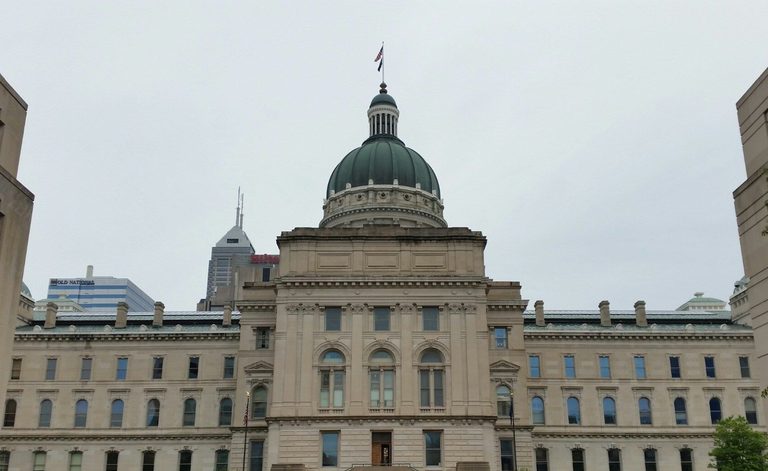
Indianapolis – Indiana’s Attorney General, Todd Rokita, is pressing a federal judge to lift a long‑standing injunction that has kept a donated monument from being installed on the Statehouse lawn. The monument, which combines the Ten Commandments, the United States Bill of Rights and the preamble to the Indiana Constitution, was originally intended for the grounds more than 25 years ago.
Legal background and recent filing
In 2000, a U.S. District Court blocked the placement of the monument after a 1971 Supreme Court ruling held that permanent religious displays on public property violated the Establishment Clause. Rokita argues that subsequent Supreme Court decisions – most notably Van Zuylen v. Perry (2022) and Kennedy v. Bremerton School District (2022) – have reshaped the legal test for such displays, emphasizing a historical‑recognition approach rather than strict separation.
Rokita’s brief, filed on behalf of the state, contends that the monument reflects Indiana’s heritage and the nation’s founding principles, and therefore should be permissible under the newer jurisprudence. He asks the court to issue a permanent injunction that would allow the monument to be moved from its current storage location in Bedford to the Statehouse grounds, near its originally intended spot.
Support from religious‑liberty advocates
The Becket Fund for Religious Liberty, a national organization that defends the free exercise of faith, is representing Indiana in the case. The group argues that states have a legitimate interest in acknowledging the role of religious heritage in American history and culture. “Recognizing the Ten Commandments alongside the Bill of Rights affirms the moral foundations that shaped our Constitution,” a Becket spokesperson said.
Local significance
For many Hoosiers, the monument is more than a stone slab; it is a reminder of the values that have guided families and communities for generations. The original monument stood on the Statehouse grounds for over three decades before vandals damaged it in 1991. The replacement, donated by the Indiana Limestone Institute, has remained in Bedford awaiting a court decision.
Local leaders and faith‑based groups have expressed enthusiasm about the prospect of the monument’s return. “Our state’s history is inseparable from the moral teachings that have guided our families,” said a representative of the Indiana Family Heritage Council. “Placing the monument where citizens can see it reinforces the principles that strengthen our neighborhoods.”
Opposition and legal concerns
Critics, including the American Civil Liberties Union of Indiana, maintain that the monument still raises constitutional concerns. They argue that even under the newer Supreme Court framework, a display that prominently features a specific religious code on government property could be perceived as endorsing one faith over others.
Rokita’s office counters that the monument’s inclusion of the Bill of Rights and the state constitution’s preamble provides a balanced historical context, mitigating any perception of favoritism. The attorney general also notes that the monument is a donation, not a government‑funded project, further distancing the state from any claim of endorsement.
Next steps
The court’s decision could come within weeks or months, depending on the docket. If the judge grants the request, the monument will be transported from Bedford and installed on the Statehouse lawn, marking a visible affirmation of Indiana’s religious heritage and constitutional foundations.
Regardless of the outcome, the case underscores a broader national conversation about how public spaces reflect America’s religious and historical legacy. Indiana’s effort to restore the monument aligns with a growing movement among states to recognize the role of faith in the nation’s founding narrative.
Original reporting: 93.1 WIBC (Indianapolis) — read the source article.