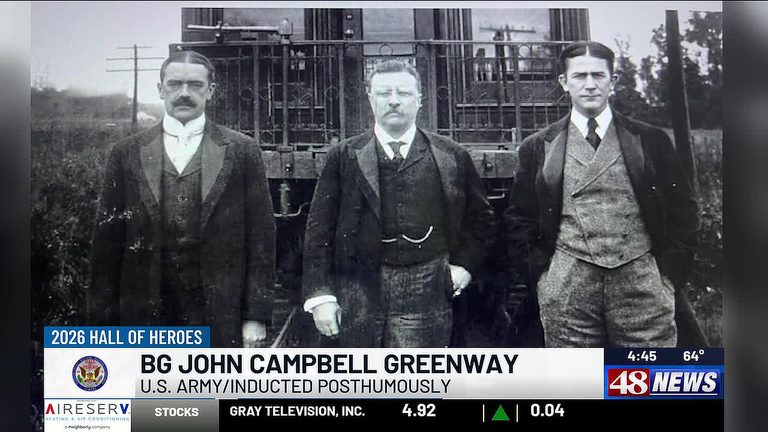
HUNTSVILLE, Ala. – A Huntsville‑born soldier who fought alongside Theodore Roosevelt and helped shape the region’s mining industry received a posthumous honor this week. Brig. Gen. John Campbell Greenway was named a 2026 inductee to the Madison County Hall of Heroes, recognizing his military bravery and contributions to industry.
Family research brings local hero back into focus
Gilbert White, Greenway’s first cousin twice removed, spent the past year delving into the life of his ancestor after learning of the connection a decade ago. “It’s just terrific to learn about him and, moreover, to learn about Huntsville’s early times,” White said.
Born in Huntsville in 1872, Greenway attended the University of Virginia before transferring to Yale University, where he excelled on the football field. “Well, at Yale, three of the years he was there on the football team, they were number one in the nation,” White recalled.
Rough Rider and battlefield valor
In 1898, Greenway joined the First United States Volunteer Cavalry—better known as the Rough Riders—during the Spanish‑American War. Theodore Roosevelt, later the 26th President, served as one of the regiment’s commanders. White noted, “Teddy Roosevelt was his commanding officer in Cuba. And, you know, the charge up San Juan Hill, John Campbell Greenway was the second one to the top.”
According to the Encyclopedia of Arkansas, Greenway was cited for bravery at the Battle of San Juan Hill and was reported to be the second soldier to reach the summit.
Industrial pioneer and controversial labor actions
Before the war, Greenway worked for Carnegie Steel and later helped develop iron‑ore mining operations in Minnesota. His career later took him to Arizona, where he played a key role in developing the New Cornelia copper mine near Ajo.
Greenway’s record also includes involvement in the 1917 Bisbee Deportation, a labor dispute in which he asked the local sheriff to remove striking miners. He was subsequently indicted over the workers’ civil‑rights claims but was acquitted.
World War I service and honors
When the United States entered World War I, Greenway volunteered again, deploying to France. He survived a gas attack in the trenches and was awarded the Distinguished Service Cross, the Army’s second‑highest decoration for valor.
Legacy remembered a century later
Greenway died in 1926 at the age of 53. A century after his passing, his story resurfaced thanks to White’s research, offering Huntsville residents a deeper connection to their city’s early history. The Hall of Heroes induction ceremony highlighted Greenway’s dual legacy as a courageous soldier and a pioneering industrialist.
“Learning about him has also helped me discover more about our hometown,” White added, underscoring the personal and communal value of preserving local history.
Original reporting: WAFF 48 Huntsville (news) — read the source article.