Albuquerque’s iconic Route 66 neon heritage is getting a fresh glow thanks to the dedicated work of local artist Robert Randazzo and collector Carlos Garcia, who are restoring and preserving vintage signs that have lit the city’s streets for decades.
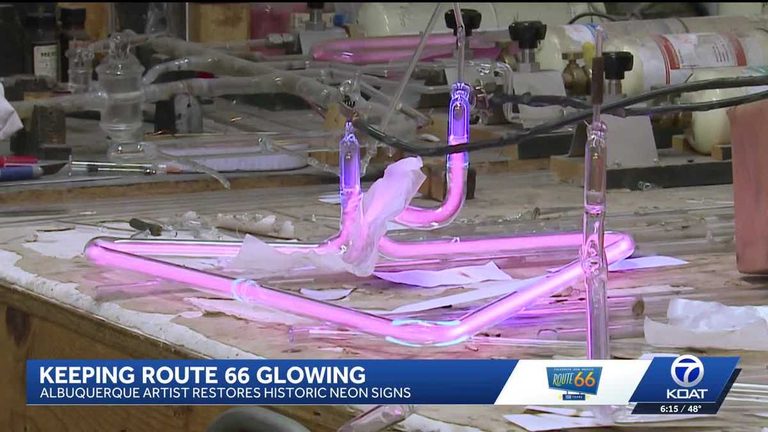
Randazzo, a neon artist with roots in Brooklyn’s Broadway sign scene, now runs a neon shop in Albuquerque that he rescued 35 years ago. He explained that many of the city’s neon pieces were failing because owners “didn’t know anything about neon.” Using his decades of experience, Randazzo is currently renovating a 20‑ to 30‑foot‑high arrow that once marked the Aztec Auto Court Motel. The restoration process involves cutting glass to full‑scale drawings, heating and shaping the tubes, inserting the electrode that delivers electricity to the gas, and sealing the pieces before filling them with gas to make the sign glow again. “There’s something about the light. When people say neon is magical, that’s what they’re talking about,” he said.
Randazzo’s work is already a familiar part of Albuquerque’s landscape. He noted projects such as the neon bridges in Nob Hill that span Central Avenue and the bridge near Coors and Central, both of which have become visual landmarks for residents and visitors alike.
Meanwhile, Carlos Garcia, together with his brother Ed, has been building a private collection of Route 66 neon signs for years, inspired by their mother’s love of neon after she studied anthropology at UNM in 1955. Garcia described his hobby as “an illness” that has grown from small oil‑can and gas‑pump signs into a substantial archive of animated and flashing pieces, including the well‑known Kurt’s Camera Corral sign in Nob Hill and the 1958 Jack’s Liquor Store sign at UNM’s Central‑University intersection.
Garcia emphasized that acquiring a sign is only the first step; the real work lies in moving, restoring, rewiring, glass‑bending, insuring, and ensuring each piece meets safety standards. He highlighted the technical difficulty of the Wagon Wheel sign, whose animated spokes require rare glass‑bending skills. “Getting to know people and their family story and the history of their business and being able to preserve a little bit of that history is by far the most important part,” Garcia said.
Both men share a common goal: to keep the neon glow of the Mother Road shining for future generations. Randazzo hopes to inspire new artisans to learn the craft, while Garcia plans to open his collection to the public once the space is complete, offering Albuquerque residents a chance to experience the city’s neon legacy up close.
What’s next: Garcia’s collection is still under renovation, and he expects to welcome visitors once the exhibit space is finished, though no specific opening date has been announced. Randazzo will continue restoring additional Route 66 signs, with more projects slated for the coming months as demand for historic neon preservation grows.