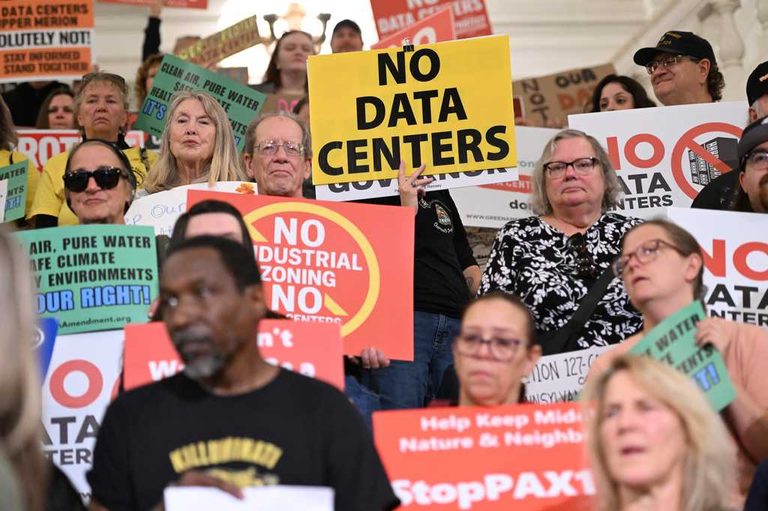
Investors reacted Thursday as AI‑related stocks slipped, reflecting voter backlash against new data‑center construction. The sell‑off followed a wave of ballot measures in which voters in 46 of 47 contests voted for stricter limits on data‑center development.
Voter sentiment and economic impact
Economic analyst Mark Hamrick noted that “opposition to data centers is perhaps one of the most surprising stories of 2026.” He explained that markets had assumed few obstacles to expanding AI infrastructure, but recent elections have introduced uncertainty.
Despite the market dip, Hamrick reminded readers that AI‑related investment has driven nearly a quarter of U.S. economic growth over the past year, according to J.P. Morgan economists. The data‑center and AI build‑out remains a key factor in national GDP growth.
Trump administration’s response
President Donald Trump warned that communities rejecting data centers risk becoming “backwards and poor.” In a statement to Hearst Television, White House spokesman Matthew Middleton said the President is “committed to maintaining American leadership in Super Intelligence, which will continue to fuel revenue growth, innovation, and productivity across our economy.”
The administration argues that data centers generate substantial local tax revenue and jobs. Virginia’s data‑center industry has produced more than $2.6 billion in state and local taxes, and Loudoun County alone collected $875 million in 2024.
Federal‑land solution
Interior Secretary Doug Burgum told Hearst Television that the administration is exploring the construction of additional data centers on “vast amounts of federal land.” He emphasized that location decisions are driven by national security and economic considerations, not by placing facilities in residents’ backyards.
Burgum highlighted remote sites such as North Dakota and Alaska, where colder climates could lower cooling costs and cheaper electricity could make operations more affordable.
Balancing environmental and consumer concerns
Critics have raised questions about environmental impact, the number of permanent jobs created, and rising electricity costs. Hamrick linked higher electricity bills to inflation pressures. The White House responded that data‑center operators should cover their own electricity expenses, and the voluntary Ratepayer Protection Pledge now includes hundreds of participating organizations, though it does not guarantee unchanged household bills.
Congressional outlook
Democratic lawmakers have introduced proposals ranging from a nationwide moratorium on new data‑center construction to legislation requiring technology firms to shoulder a larger share of electricity costs. While these measures could gain traction under incoming Democratic majorities, any restrictions would still require President Trump’s signature or a congressional supermajority to override his veto.
Thus, the administration remains poised to accelerate America’s AI expansion while addressing voter concerns through federal‑land development and continued emphasis on job creation and tax revenue.
Original reporting: WPBF (Treasure Coast / Hearst) — read the source article.