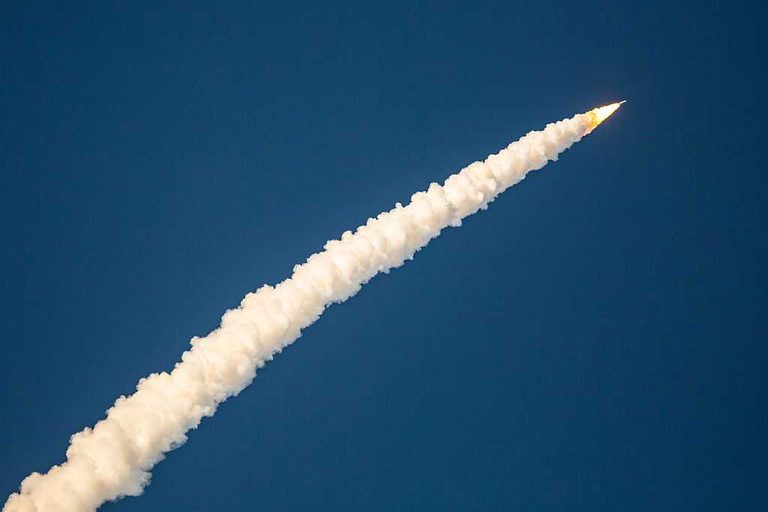
A research team at the Department of Earth Sciences, National Cheng Kung University in Taiwan, has published a preliminary analysis of the atmospheric effects of NASA’s Artemis II mission. The scientists examined data collected during the launch and the Orion capsule’s subsequent orbital‑maneuver burns and identified three distinct disturbances in the ionosphere, the charged‑particle layer of Earth’s upper atmosphere.
What the ionosphere does
The ionosphere sits above the Earth’s atmosphere and is composed mainly of ionized gases. It plays a critical role in radio‑wave propagation, allowing many communication satellites and Global Navigation Satellite System (GNSS) signals—including the Global Positioning System (GPS)—to travel reliably across the globe. When the ionosphere is disrupted, those signals can experience temporary degradation.
How Artemis II impacted the ionosphere
According to the study, the first disturbance occurred at the moment of the rocket’s liftoff, when the massive thrust generated a rapid influx of charged particles. A second disturbance was recorded during the Orion capsule’s orbital‑maneuver engine firings, which produced additional localized heating and ionization. The third event was observed as the capsule entered a higher‑altitude trajectory, creating a brief but measurable alteration in the ionospheric density over the launch region.
“This is the first time a single space mission produced such multiple ionospheric disturbances over the same region,” the researchers wrote. Their analysis relied on GNSS and GPS observations collected from ground‑based receivers and satellite platforms around the time of the launch.
Historical context
The authors note that ionospheric disturbances are not new. Similar effects have been documented during rocket and missile launches dating back to the 1970s, including the Apollo missions and the 1973 launch of the Skylab space station. Those events were also described as “anthropogenic space weather,” a term that captures human‑induced changes in the near‑Earth environment.
Why the findings matter
Understanding how large‑scale launches affect the ionosphere is valuable for space agencies, satellite operators, and users of navigation services. The temporary disruptions observed during Artemis II could influence GPS accuracy for applications ranging from everyday navigation to autonomous‑vehicle guidance. The researchers suggest that further study of these human‑made space‑weather events will help agencies plan future missions, especially as NASA prepares for a return to the Moon and eventual crewed missions to Mars.
The study has been posted as a preliminary communication in the journal Geophysical Research Letters and is awaiting formal peer review.
Original reporting: KCCI Des Moines — read the source article.