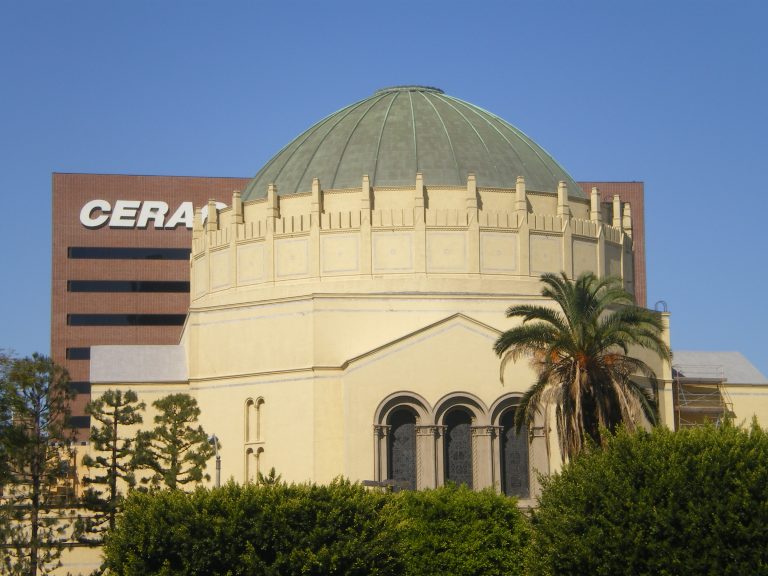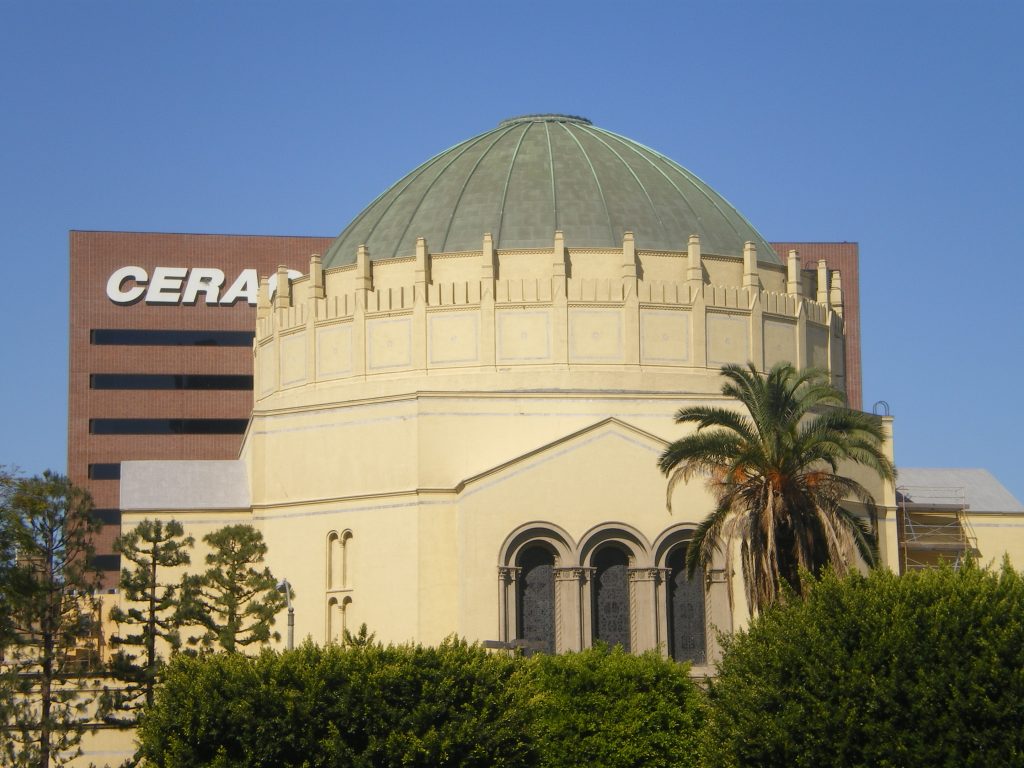
If you’ve driven Wilshire Boulevard between Vermont and Western, you’ve probably slowed down for it without knowing quite what you were looking at. The Wilshire Boulevard Temple — formally known as Congregation B’nai B’rith, though almost nobody calls it that — sits on the north side of the street in Koreatown like something that got misplaced from a Mediterranean hilltop and never found its way back. The dome is Byzantine. The stonework is ornate. At rush hour, with the buses rolling past and a pupusa cart on the corner, the whole picture is genuinely disorienting in the best possible way.
The temple was completed in 1929, and its scale still stops people cold. The sanctuary seats roughly 1,600, and the first thing you notice inside is the mural — a 320-foot panoramic fresco wrapping the entire interior, painted by Hugo Ballin over several years and depicting scenes from the Hebrew Bible alongside figures from Jewish history. Moses, Abraham, Maimonides, Spinoza, the Maccabees. The color palette runs warm and deep, and the craftsmanship is meticulous in a way that feels almost impossible for the period. It’s one of the largest murals in the United States and, on a purely visual level, among the most remarkable things you can walk into anywhere in Los Angeles.
Getting inside requires some planning. The temple is an active congregation, not a museum, so drop-in touring isn’t the model. The best approach is a guided tour, which the Wilshire Boulevard Temple offers periodically — typically on Sunday mornings, though the schedule shifts, and checking their website or calling ahead is genuinely necessary, not just advisable. Tours last about an hour and cover the sanctuary, the history of the congregation (founded in 1862, one of the oldest Jewish congregations on the West Coast), and the decades-long restoration project that wrapped up around 2013 after a $150 million effort.
That restoration matters. By the late twentieth century, the building had deteriorated badly — deferred maintenance, earthquake damage, neglect. The murals had faded and cracked. What you see today is essentially the temple as it was meant to look at its opening, which makes it both a historical artifact and a genuinely functioning space. High Holy Day services here draw thousands. Weddings, bar mitzvahs, community events — this is not a preserved relic; people use it every week.
Tour cost is typically around $18 for adults, less for students and seniors. Parking is available in the lot behind the building off 6th Street, though on a Sunday morning the surrounding Koreatown streets are usually manageable. The neighborhood itself rewards some time — there are excellent Korean spots within a few blocks in every direction, and the stretch of Wilshire through here has its own compressed, layered quality that’s pretty specific to Los Angeles.
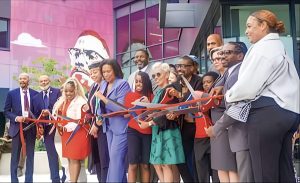
The question people ask most often, apparently, is why the temple stayed in Koreatown when the Jewish population largely moved west decades ago. The answer is complicated and involves a deliberate institutional commitment to the building and the neighborhood rather than a simple inertia. The congregation has built a charter school on the campus. They’ve put real money into community programs. Whether you find that admirable or insufficient probably depends on what you bring to the conversation, but it’s a more interesting story than the architecture alone would suggest.
Go on a clear morning if you can. The light inside the sanctuary shifts through the day, and the murals read differently depending on where it falls.