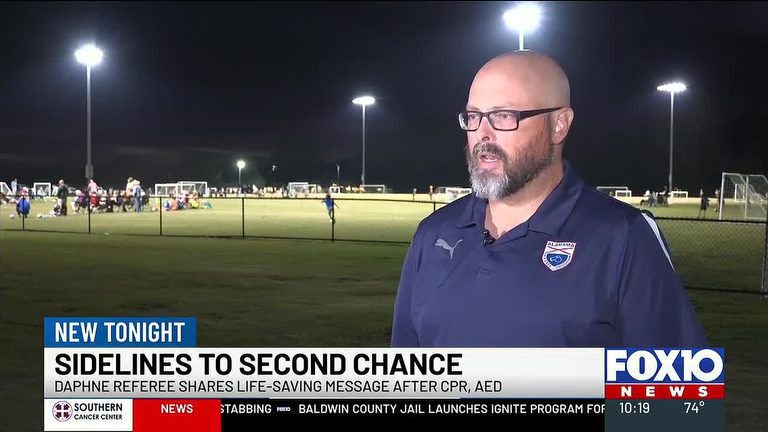
Daphne, Ala. – A local youth‑soccer referee is alive today because community members on the sideline acted without hesitation when his heart stopped during an Oct. 11 match at Al Trione Sports Complex.
Brock Cole, a longtime volunteer official, collapsed in the second half of the game. “I just immediately got light‑headed… I never even got the opportunity to blow the whistle,” Cole recalled. “Next thing you know, you wake up, and you’re laying on the ground with all these people around you.”
Immediate Bystander Response Saves Life
Witnesses rushed onto the field, began chest compressions, and retrieved an automated external defibrillator (AED) from a nearby concession stand. Dr. Christopher Malozzi, a cardiologist with USA Health who was watching a game on an adjacent field, joined the effort. “Everybody was doing everything exactly the way it needed to be done,” Malozzi said. “Doing CPR like it should be done and getting that AED on him and shocking him… that is probably what saved his life.”
Family Credits Quick Action
Cole’s wife, Jolene Cole, praised the rapid response. “They didn’t stop. They didn’t wait. They reacted,” she said. “And that is the reason he’s standing here today.”
Medical Follow‑Up and Recovery
Doctors later discovered a 75% blockage in Cole’s left anterior descending artery – often called the “widow maker” – plus two additional blockages. He underwent double‑bypass surgery and is now on the road to recovery.
Community Call to Learn Hands‑Only CPR
Inspired by his experience, Cole shared his story at the Baldwin County Heart Walk, urging others to learn hands‑only CPR. “Learn it. It’s so important,” he said. “You can’t wait for the ambulance to get there. It could happen to anybody.”
Residents can participate in the Mobile Heart Walk this Saturday on the University of South Alabama campus. Activities and CPR demonstrations begin at 8 a.m., with the walk departing at 8:45 a.m. from the Moulton Bell Tower. Training resources and course sign‑ups are available through the American Heart Association and the American Red Cross.
According to Dr. Malozzi, roughly 90% of individuals who suffer out‑of‑hospital cardiac arrests do not survive, underscoring the critical importance of immediate bystander action before emergency responders arrive.
Original reporting: FOX10 WALA Mobile (news) — read the source article.