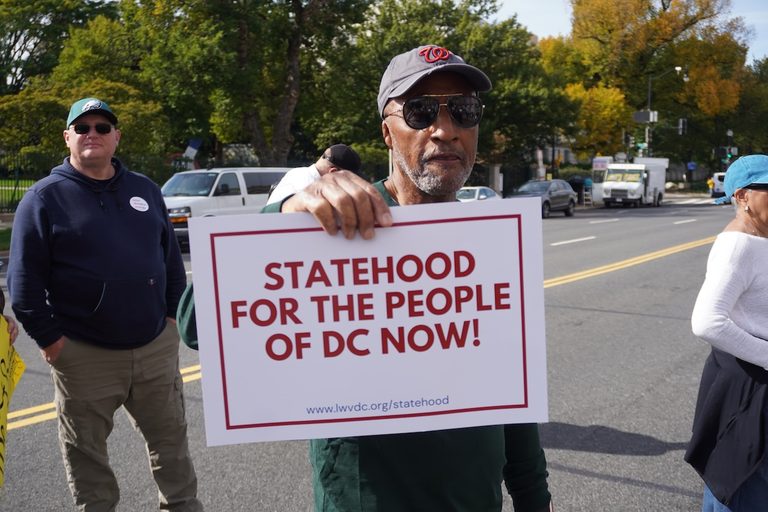
Washington, D.C. – The Democratic Party’s sweep of the November 3 midterm elections has given the nation’s capital a fresh opportunity to pursue statehood. Newly elected Delegate‑elect Robert White, a longtime member of the D.C. Council, will join Congress with the goal of securing full representation for the District’s nearly 700,000 residents.
Local leaders see a window of opportunity
“The midterm elections have created an opportunity to turn renewed energy into meaningful progress,” said Amy Vruno, executive director of DC Vote. “With Democrats taking control of both the House and Senate, we have a chance to make D.C. statehood a priority and advance the full democratic rights that D.C. residents have been denied for more than 200 years.”
White, who stepped down from his at‑large council seat to run for the delegate position, told reporters that statehood would not only give District voters a voice in Congress but also affect national legislation on health care, reproductive rights and other key issues. “The agenda gets done if you have the votes — and D.C. statehood gives you more votes,” he said.
Congressional dynamics and hurdles
While the Democratic majority is a significant boost, the path to statehood remains steep. In the 119th Congress, 44 senators have co‑sponsored the statehood bill, still short of the 60 votes typically needed to overcome a filibuster. President Trump retains the power to veto any legislation, which would then require a two‑thirds majority in both chambers to override.
Republican critics have questioned the constitutionality of admitting the District as a state through ordinary legislation and have floated alternatives, such as returning residential portions of Washington to Maryland while preserving a smaller federal district for government buildings.
Support from incoming lawmakers
DC Vote identified several newly elected senators who have pledged support for the cause, including South Carolina Senator‑elect Dr. Annie Andrews, Maine Senator‑elect Troy Jackson, and former Ohio Senator Sherrod Brown, who backed statehood during his prior Senate service. Policy expert Tom Lee described the post‑election environment as “the best chance in a generation” for the District to make its case.
Local impact of federal control
During President Trump’s return to the White House, Congress froze the District’s spending at 2024 levels, temporarily withholding roughly $1 billion of locally generated tax revenue. The freeze forced city officials to manage schools, police, emergency services and neighborhood programs under constraints set by lawmakers who answer to voters elsewhere.
The ACLU of the District of Columbia invoked the nation’s founding struggle against taxation without representation, urging an end to the arrangement. “Can’t believe we’re still saying this 250 years later: It’s time to end taxation without representation,” the organization posted on social media.
Local officials prepare for a new congressional relationship
Mayor‑elect Janeese Lewis George has already begun discussions with federal leaders, including House Democratic leader Hakeem Jeffries, to protect the District’s authority. The incoming House Oversight Committee chairmanship is expected to shift from Republican James Comer (R‑Ky.) to Democrat Robert Garcia (D‑Calif.), a change that could ease congressional attempts to overturn local policies.
White acknowledges that not all Democrats are uniformly supportive. Some have joined Republicans in voting to overturn District laws, and competing priorities such as health‑care reform and oversight of the Trump administration vie for attention.
Why statehood matters beyond representation
Vruno emphasized that statehood is about more than a vote. “It is about the fundamental promise of our democracy: that every American deserves a voice in the laws that govern them,” she said.
As the new Congress convenes, the District’s advocates will focus on securing commitments from existing supporters, winning over undecided members, and mobilizing grassroots backing in states where congressional delegations will ultimately decide the bill’s fate.
Original reporting: The Washington Informer — read the source article.