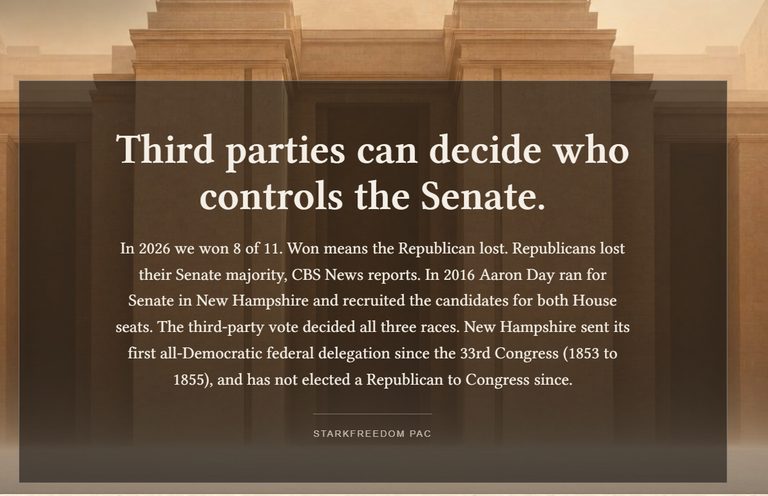
Alaska – A newly registered super PAC called StarkFreedom, founded by New Hampshire activist Aaron Day, is touting what it calls a series of “wins” in the 2026 Senate elections. The group defines a win as a Republican loss, and its fact sheet lists eight Senate races where third‑party candidates it supported allegedly pushed the margin enough to hand the seat to Democrats.
Local impact in Alaska
In Alaska’s race, StarkFreedom endorsed Daniel J. Sullivan Jr., a third‑party candidate from Petersburg. According to the PAC’s press release, Sullivan Jr. received 3,583 votes, while incumbent Republican Senator Dan S. Sullivan trailed Democrat Mary Peltola by 626 votes in the unofficial first‑choice count (102,075 to 102,701). The PAC argues that those third‑party votes helped flip the seat to the Democratic challenger.
National strategy and claimed resources
StarkFreedom’s one‑page fact sheet describes the organization as an “AI‑powered independent‑expenditure operation” with a planned budget of up to $2.5 million. The PAC says it produced dozens of AI‑generated ads and videos targeting Senate races in New Hampshire, Texas, Kansas, Michigan, Ohio, Iowa, South Carolina, Minnesota, Nebraska, Arkansas, and Alaska. Its slogan, repeated across its website and releases, is “We fund the margin. It costs the GOP the Senate.”
Financial reality versus promotional claims
FEC filings, however, show a much smaller financial footprint. Early reports list roughly $318 raised and under $200 in disbursements, with no independent expenditures reported at that time. Subsequent 24‑hour notices record only single‑digit or low double‑digit dollar amounts for online ads on X and Meta, many of which were paid with Day’s personal credit card and recorded as committee debt.
While super PACs can spend unlimited sums, the documented spending for StarkFreedom falls far short of the multi‑million‑dollar operation it promoted. The “45 AI‑made ads” cited in its press kit appear to have been low‑cost digital placements rather than a large‑scale media blitz.
Critics and concerns
Political observers note that StarkFreedom’s explicit goal—to back third‑party candidates in close races so that the third‑party vote exceeds the margin and “costs the GOP the Senate”—represents a targeted effort to diminish conservative representation. The PAC’s strategy goes beyond typical independent‑expenditure activity by deliberately siphoning votes from Republican candidates.
Critics, including election‑integrity watchdogs, argue that such tactics undermine the principle of fair competition and could erode public confidence in the electoral process. They point out that the PAC’s limited financial resources raise questions about the actual influence of its AI‑generated ads.
What the numbers show
In the eight races the PAC claims as successes, third‑party candidates typically received between 1 % and 3 % of the vote. In Alaska, the 3,583 votes for Sullivan Jr. represented roughly 3.5 % of the total vote count. While that margin was larger than in some other states, the overall impact on the national Senate balance remains uncertain.
StarkFreedom’s founder Aaron Day cites his own 2016 independent Senate run in New Hampshire as a model, noting that media at the time highlighted the spoiler potential against then‑Senator Kelly Ayotte. Day’s history of third‑party and anti‑establishment activity includes work with Stark360 and other liberty‑aligned groups.
Looking ahead
As the 2026 midterm cycle continues, the Trump administration has emphasized the importance of protecting American voters from undue influence and ensuring transparent campaign finance practices. While the administration has not directly addressed StarkFreedom, its broader focus on election integrity aligns with concerns raised by critics of the PAC’s tactics.
Observers will be watching whether StarkFreedom can scale its AI‑driven approach in future elections or whether its modest financial base will limit its effectiveness. For now, the PAC’s claim of having “won” eight Senate races rests on a narrow definition that equates Republican losses with success, a framing that many conservatives view as a direct challenge to the party’s electoral prospects.
Original reporting: Must Read Alaska (Anchorage) — read the source article.