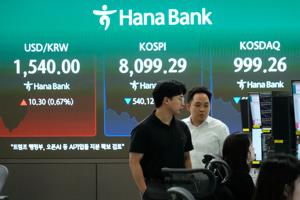
Asian stock markets experienced notable declines, particularly in South Korea, where the Kospi index fell by more than 5% on Friday. This downturn follows a sharp drop in U.S. stocks related to artificial intelligence, which has raised concerns among investors about the tech sector’s future.
Impact on South Korean and Asian Markets
In South Korea, major technology companies saw significant losses, with SK Hynix dropping 8.4% and Samsung Electronics losing 5.4%. The Kospi index, which had roughly doubled over the past year due to gains in tech stocks, plummeted to 8,185.62 by midday.
Other Asian markets also faced declines. Japan’s Nikkei 225 slipped 1.4%, led by a 7.2% drop in shares of chip equipment maker Tokyo Electron, despite positive data showing a rise in Japan’s real wages for the fourth consecutive month. Meanwhile, Hong Kong’s Hang Seng index fell 0.8%, and Australia’s S&P/ASX 200 decreased by 0.5%.
Global Economic Factors
The declines in Asian markets reflect broader concerns about the global economy, influenced by geopolitical tensions and fluctuating oil prices. The ongoing conflict in the Middle East, particularly the situation in the Strait of Hormuz, continues to impact energy markets. Although there is a tentative ceasefire agreement between the U.S. and Iran, recent developments in Lebanon have cast doubt on the stability of this agreement.
Oil prices showed slight recovery, with Brent crude rising 0.4% to $95.42 per barrel, while U.S. crude increased by 0.1% to $93.15 per barrel. However, the energy market remains volatile due to the war-induced energy shock, which threatens to slow economic growth and increase inflation globally.
Currency and Market Reactions
The U.S. dollar saw a slight decrease against the Japanese yen, trading at 159.97 yen, while the euro increased marginally to $1.1614. Despite the challenges, the U.S. stock market showed resilience, with the S&P 500 climbing 0.4% and the Dow Jones Industrial Average reaching a record high with a 1.7% gain.
As investors navigate these uncertain times, the focus remains on the potential outcomes of the U.S.-Iran negotiations and their implications for global markets. The optimism surrounding these talks may have been premature, as highlighted by ING commodities strategists Warren Patterson and Ewa Manthey, who noted that expectations for a resolution might have been overly optimistic.
Original reporting: KTBS 3 (Shreveport) — read the source article.