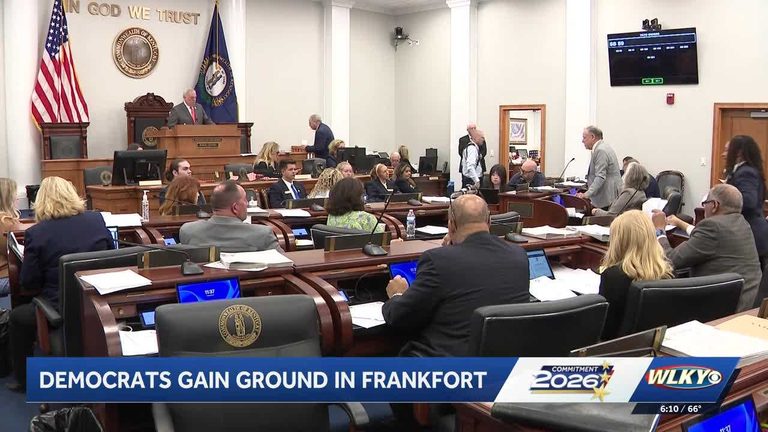
Kentucky voters delivered a notable shift in the state General Assembly on Tuesday, with Democrats flipping nine seats that had been held by Republicans in both the House and Senate. The gains came in urban districts around Louisville, Northern Kentucky and Lexington, areas where Republican leaders had anticipated strong support.
Republican leadership attributes losses to national forces
Senate President Robert Stivers said this marks the first time Republicans have lost seats in the Senate since 2012. He pointed to what he called “trickle‑down politics” and a broader nationalization of the election, noting, “I don’t think this, in many places, was a vote for somebody. I think it was a vote against something.” Stivers added that candidates were judged on “national and international dynamics, not things that were here.”
Stivers also highlighted the concentration of the flipped seats in urban areas, describing it as “urban area influence.” He argued that the Democratic Party’s national messaging outweighed local accomplishments, saying, “It was a nationalization of the issues by the Democratic Party.”
Key races and surprising upsets
Among the most unexpected results, longtime Senator Julie Raque Adams was unseated by Democrat Sarah Cole McIntosh, and Representative Jason Nemes lost to Democrat Jennifer Hardin. In the Louisville corridor, Republicans Ken Fleming, Susan Tyler Witten, Chris Lewis and Jared Bauman all fell to Democratic challengers, as did Senator Lindsey Tichenor in District 6.
Further south of Lexington, Representative Matt Lockett was defeated by Democrat Ryan Stanford, and in Northern Kentucky incumbent Stephanie Dietz was beaten by Democrat Aaron Currin. All of these contests were decided by margins of roughly 1,000 votes.
Funding achievements cited amid defeat
Stivers pointed to the General Assembly’s allocation of more than $2 billion to Louisville and Jefferson County over recent years, crediting former Republican leaders Raque Adams and Nemes for securing those appropriations. “They reached out to work with a Democratic mayor in Louisville and again, to produce a lot of big types of appropriations and earmarks. The best that Louisville has probably seen in 30 years, and people didn’t respect that or want that, apparently,” Stivers said.
Despite the losses, Democrats outperformed Republicans in Jefferson County by over 46,000 votes, underscoring the urban advantage they enjoyed in this cycle.
Looking ahead
The Kentucky General Assembly is scheduled to reconvene in January, where the new Democratic members will join the chamber and the Senate. Republican leaders have indicated they will focus on rebuilding support in urban districts and emphasizing local achievements in future campaigns.
For Kentucky residents, the election results signal a more competitive legislative environment and a reminder that national narratives can heavily influence local outcomes.
Original reporting: WLKY Louisville — read the source article.