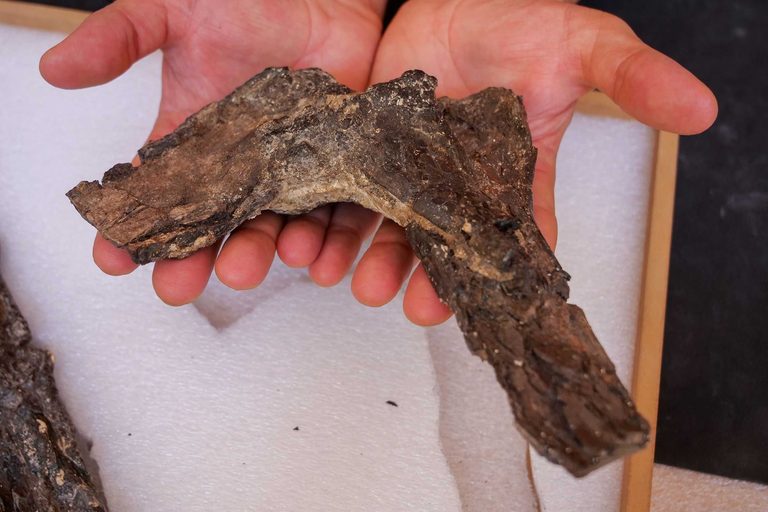
Scientists from Curtin University in Perth, Australia, have announced what they describe as the strongest evidence yet that red blood cells can survive fossilization. The discovery comes from a partial hind‑limb bone of the theropod Aratasaurus museunacionali, which lived about 115 million years ago during the Early Cretaceous.
New methods reveal cellular detail
The team combined high‑resolution microscopic imaging with chemical analyses to locate oval‑shaped microstructures inside the bone’s vascular canals. Those structures resemble red blood cells, and the researchers also detected heme – the iron‑containing molecule that gives blood its color and carries oxygen.
According to lead author Kliti Grice, an organic geochemist and John Curtin Distinguished Professor, this is the first time heme has been identified in situ, meaning directly within the cell‑like structures in a dinosaur fossil.
Why the find matters
“The exciting implication is not just what we have found in this dinosaur,” Grice wrote in an email. “It is that we now have approaches that can be applied to other fossils to ask how much original biological information may still be hidden within them.” If similar evidence appears in additional specimens, scientists could ask more sophisticated questions about the physiology of extinct animals.
The bone was excavated in 2008 at the Mina Pedra Branca site in the Romualdo Formation of northeastern Brazil, a locality known for exceptionally preserved fossils. Researchers believe low‑oxygen, stagnant water conditions at the site slowed decomposition, helping delicate organic material survive.
Expert reactions and cautions
Not all paleontologists are convinced the structures are genuine red blood cells. Mary Schweitzer, professor emeritus at North Carolina State University, noted that the shapes and sizes differ from those of modern birds and crocodilians, and that the manganese oxide (hausmannite) found alongside the cells is not present in living red blood cells.
Schweitzer also said the findings do not yet meet established standards for confirming fossilized blood cells, but she praised the multiple analytical techniques as an “exciting advancement for the field.”
Timothy Cleland of the Smithsonian Institution’s Museum Conservation Institute added that while heme and DNA are distinct molecules, the presence of heme does not guarantee DNA preservation. He suggested the study opens new avenues for exploring heme‑b preservation in other exceptional fossil sites.
Future research directions
Grice’s team plans to examine fossils from a range of species, time periods, and depositional environments to determine how widespread this type of molecular preservation might be. Such work could eventually help scientists understand how dinosaurs transported oxygen, how their tissues functioned, and how their biology compares to modern animals.
While the discovery does not bring us any closer to recreating dinosaur DNA, it does provide a tangible step toward uncovering the molecular chemistry of deep time, a realm many once thought impossible to explore.
Original reporting: 40/29 / KHBS (NW Arkansas) — read the source article.