A couple of months ago, a farmer in the El Paso area reached out with a straightforward question: Could the state force them to plug their water wells? I told them no. Under Texas law, private landowners own the groundwater beneath their property. The Rule of Capture has long governed this resource. Absent narrow exceptions for malice, willful waste, or subsidence, a landowner cannot be compelled by the state to abandon their own well simply because someone else wants the water.
That farmer then asked if I would come speak to a larger group of farmers and ranchers about what was happening in their area. I said yes and set a date. I personally invited many people. We expected roughly 75 to 100 attendees—people who live and work the land in El Paso and Hudspeth Counties and who had every reason to be concerned about the rapid expansion of data centers and the water demands that come with them.
When we arrived, the atmosphere was markedly different. There may have been a dozen people in the room. The tone was standoffish, almost hostile. One of those present was a governor appointee to the Texas Water Development Board who attempted to take control of the meeting. We had traveled there simply to listen, to understand the concerns on the ground, and to offer what clarity we could. Those who were there were tight-lipped and clearly intimidated. We left with far less information than we had hoped for.
In the weeks since, follow-up conversations have filled in the picture. What has emerged should alarm every Texan who values private property, rural communities, and the basic ability to sustain life on the land.
Farmers and residents in the rural parts of El Paso and Hudspeth Counties have been approached by people connected to data-center projects. They are being told that water lines are being run into rural areas and that the companies want to map potential connections. Some landowners have considered tying into those lines as a backup supply during dry periods. The message they have received is clear: if you connect to the line, you will be required to plug your wells.
That is not a technical detail. It is a transfer of control. A private well is independence. Once it is plugged and the only source is a line controlled by interests tied to industrial water users, the landowner becomes a customer. Prices, availability, and conditions can change. The water that once belonged to the land and the family that worked it becomes something that can be rationed or priced by others.
The same pattern is already visible elsewhere. In Childress, Texas, a data-center presence has coincided with the local aquifer being drawn down below the level of the city’s and private residential wells. Residents and the community are now in the position of needing to buy water associated with the data-center operation. Public accounts emphasize company offers to build pipelines and treatment capacity from their own wells as a temporary bridge while the Greenbelt Lake system struggles under drought. Local experience on the ground is that the aquifer that once served ordinary wells has been lowered, and the practical result is dependence on water the industrial project controls. Under Texas’s Rule of Capture, a large pumper can lawfully draw groundwater even when it affects neighbors. The legal right does not erase the practical outcome for the people whose wells go dry.
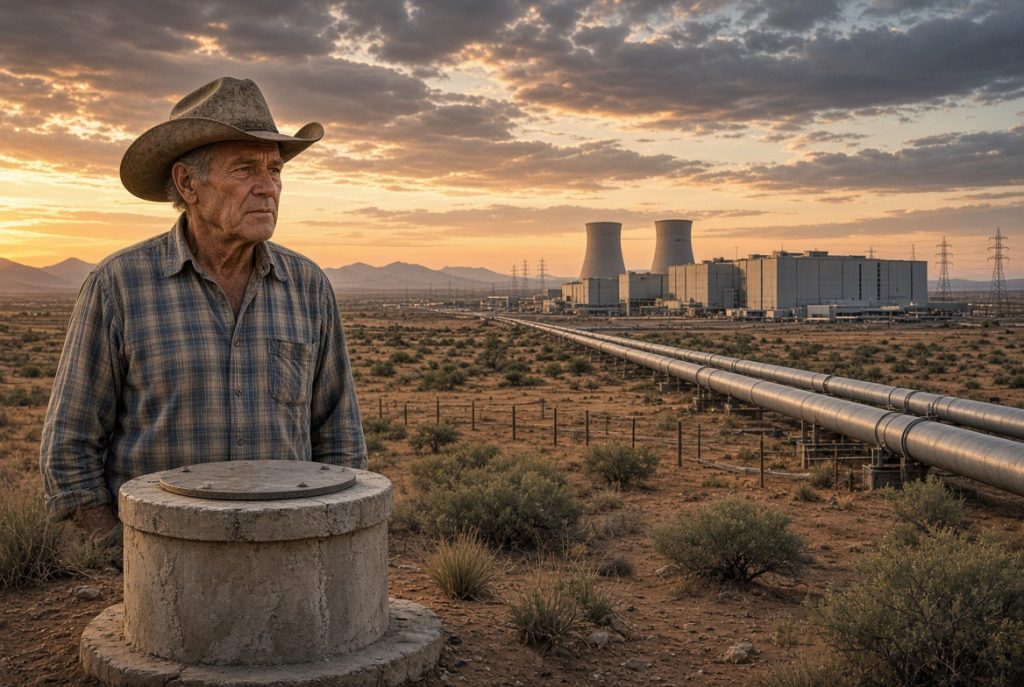
These developments are not isolated. Data centers are proliferating across Texas, including major projects in the El Paso region and a confirmed multi-billion-dollar facility in Hudspeth County near Desert Haven. Officials and developers emphasize job creation, closed-loop cooling, one-time water use, or contributions to local infrastructure. Residents and farmers report the opposite priority: water first for the facility, with rural communities left managing the consequences. The Texas Water Development Board, groundwater conservation districts, and local officials are involved in planning and reporting, yet the people who own the land and the wells often learn the full scope only after decisions are well advanced.
You cannot have life, liberty, or the pursuit of happiness without reliable, independent access to water. That is not rhetoric. It is the foundation of any functioning farm, ranch, or household in a state where aquifers are already under pressure from drought and competing demands. Global organizations have been open about their view of water. The World Economic Forum has repeatedly framed water infrastructure gaps, water rights, and water-related investment as major economic opportunities measured in the trillions of dollars, with high returns in GDP and jobs. United Nations processes treat water as a strategic resource whose management and financing must be coordinated at the international level. When those same global conversations meet local projects that require landowners to abandon their own wells in exchange for a connection, the result is not abstract. It is a concrete shift of control away from the people who live on the land.
Texas has long treated groundwater as a private property right. That principle is under practical stress when industrial users can drill high-capacity wells, run lines into rural areas, and condition access on the permanent surrender of existing wells. Farmers and ranchers who have sustained communities for generations are being asked to trade independence for a promise of backup supply controlled by others. The intimidation and low turnout at the El Paso meeting suggest that many already understand the pressure and are hesitant to speak openly.
The response cannot be passive. Landowners should refuse any arrangement that requires plugging existing wells as a condition of connecting to a new line. They should document well depths, water levels, and quality before any large new pumping begins nearby. They should demand full transparency on water sources, projected volumes, and aquifer modeling from both developers and state agencies. Groundwater conservation districts, where they exist, and the Texas Water Development Board must prioritize the rights of existing users over new industrial demand. And every Texan who values property rights should recognize that water is not a commodity to be captured by the highest bidder or the most connected project; it is the prerequisite for everything else.
We went to El Paso to listen. What we have learned since is that the stakes are higher than a single meeting. The quiet effort to map rural connections and condition them on abandoning private wells is a direct threat to the independence that has defined rural Texas. It is time to treat it as such.