Rapid City, SD – As a fresh blanket of snow covers the Black Hills, fire officials are reminding property owners that winter slash‑pile burning permits do not automatically mean conditions are safe. Assistant fire management officer Seth Stevens of the Hot Springs District cautioned that snow can melt quickly when temperatures rise or winds pick up, turning a seemingly harmless burn into a wildfire risk.
Permit season runs Nov. 1 – Mar. 31
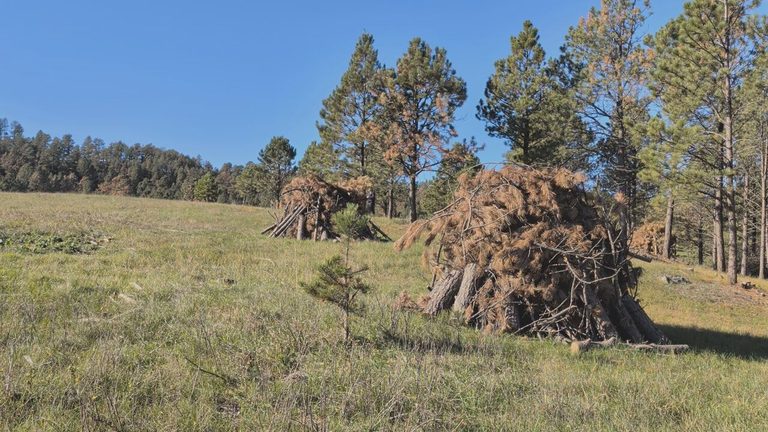
South Dakota Wildland Fire issues slash‑pile burn permits for the season from November 1 through March 31. Permits allow qualifying owners to burn accumulated woody debris – branches, brush and other natural vegetation – when specific weather criteria are met.
Snow‑cover rules
Stevens explained that pile size determines the required snow depth. Small piles (about 6 feet wide and tall or less) need at least 2 inches of continuous snow cover; larger piles must have at least 6 inches. However, the snow present at ignition is only part of the equation.
“The biggest thing is paying attention to the weather,” Stevens said. “Just because we have snow today doesn’t mean we’re going to have snow tomorrow or even three, four, five days out.” He recommends ensuring snow will remain on the ground for several days after lighting the pile.
Weather can change fast
Black Hills weather is notoriously variable. Stevens cited a recent example near Hot Springs where snow on one day was followed by 65 °F temperatures and 16 % relative humidity the next. Such rapid shifts can melt protective snow, dry out surface vegetation and create conditions ripe for fire spread.
Wind adds another hazard by carrying burning embers onto surrounding grass or pine needles. Even if a pile appears contained, embers can smolder in needle beds and reignite when dry, windy weather returns. “It could be 40 °F and windy out, 15 % RH, and then it’ll pop up out of that needle bed and take off on you,” Stevens warned.
Terrain matters
North‑facing slopes tend to retain snow longer than south‑facing slopes, meaning snow conditions can differ across a single property. Stevens noted his district has been unable to conduct its own slash‑pile burns for the past two winters due to insufficient snow.
Safety steps for landowners
Fire officials advise several practical measures:
- Keep a rake and shovel handy to move burning material toward the center as the pile diminishes.
- After the visible flames subside, “mop up” by repeatedly soaking and stirring ashes with a bucket of water or garden hose.
- Hover the back of your hand above the ashes to detect lingering heat without touching the material.
- Only consider the fire extinguished after ashes are thoroughly soaked, stirred and cooled.
Stevens emphasized that escaped slash piles are not uncommon in winter months. While he did not have exact figures, his office frequently responds to such incidents.
Legal and financial responsibility
Landowners who permit a slash‑pile to escape may be held liable for suppression costs and could endanger neighboring properties. Permit holders must contact their local county dispatch center before lighting a pile; the dispatch number is printed on the permit.
Permits and detailed restrictions are available through South Dakota Wildland Fire, which maintains district offices in Hot Springs, Custer, Rapid City and Lead for additional questions.
Bottom line
A valid permit and snow on the ground are only the starting points. Fire officials urge landowners to monitor forecasts, respect snow‑cover requirements, manage piles responsibly and ensure every ember is fully extinguished before leaving the site.
Original reporting: KOTA (Gray) – local — read the source article.