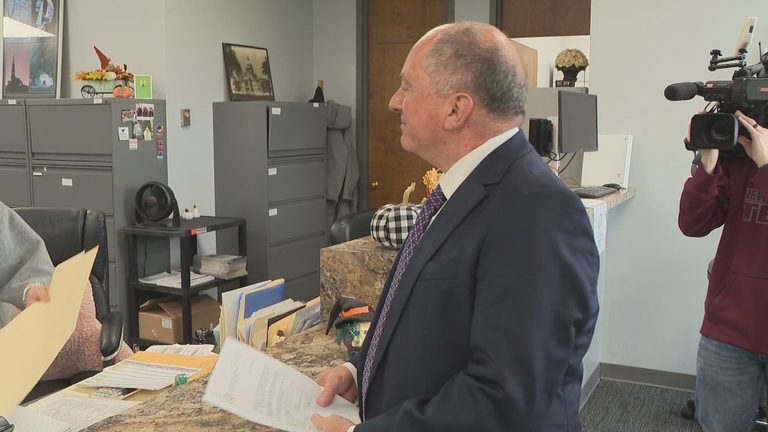
Providence — Independent gubernatorial hopeful Ken Block delivered a formal campaign‑finance complaint to the Rhode Island Board of Elections on Wednesday, accusing Democratic candidate Helena Foulkes of violating the state’s $25,000 cap on party “in‑kind” contributions.
Complaint details
Block’s filing asserts that the Rhode Island Democratic State Committee reported more than $220,000 in in‑kind donations to Foulkes’ campaign, including the cost of negative mailers that criticize Block’s record. Under Rhode Island law, any “preparation and airing of television and/or radio advertisements and the cost of any print advertisements” must be counted toward the $25,000 limit.
“The Democratic Party appears to have violated the $25,000 cap in spending that they can use to support Helena Foulkes’ communications,” Block told NBC 10 as he left the Board of Elections. “The Helena Foulkes campaign has been spreading lies about me and they have been doing so violating campaign‑finance law and someone needs to hold her accountable.”
Foulkes campaign response
Foulkes’ campaign counters that the mailed pieces are not advertising and therefore do not fall under the in‑kind limit. Campaign spokesperson Eric Hyers said, “Ken Block is whining about mailers from the RIDP that show he is really a Republican who opposes the Affordable Care Act and called it ‘horrible.’ Unfortunately for Ken Block, mailers like the ones that show he is really a Republican who opposes the ACA do not count towards the $25k in‑kind limit, so voters will continue to learn about how he’s really a Republican who called the ACA ‘horrible.’”
Legal interpretation
Block’s campaign manager Matthew Schweich argues that Rhode Island’s campaign‑finance manual groups mailers with print advertisements for the purpose of the contribution cap. “Rhode Island campaign finance laws make no distinction between a print advertisement and a mailer to voters. For the purposes of applying the in‑kind contribution limit, a mailer is a printed advertisement,” Schweich wrote to NBC 10, adding that two Board of Elections investigations in 2017 and 2018 support this interpretation.
The Board of Elections spokesman replied, “All Board of Elections campaign finance investigations are confidential unless or until the Board finds there is a reason to believe a violation has occurred.” Democratic Party Executive Director Katherine Riordan told NBC 10 that the party had not yet received the complaint.
What’s at stake
If the Board determines a violation, the party could be required to reimburse the excess amount or face penalties, reinforcing the state’s effort to keep campaign spending transparent and within statutory limits. The dispute also highlights a broader debate over how modern campaign tactics—especially targeted mailers—fit within traditional advertising definitions.
Both campaigns are expected to continue monitoring the filing as the gubernatorial race heads toward the November primary, where voters will decide which candidate will represent each party in the general election.
Original reporting: NBC 10 WJAR (Sinclair) – local — read the source article.