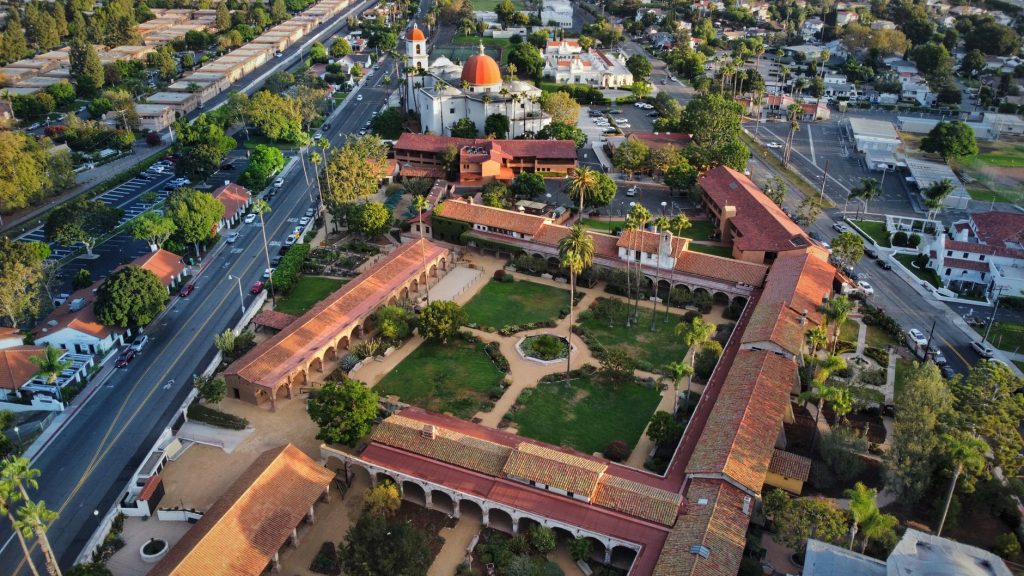
Around nine on a Tuesday morning, before the tour buses show up and the downtown foot traffic gets going, the garden behind Mission San Buenaventura is about as quiet as Ventura gets. A couple of sparrows. Someone’s grandmother on a bench. The fountain doing its thing. It’s not exactly undiscovered territory — the mission has been here since 1782 — but it’s the kind of place that rewards showing up early and not rushing through it.
The mission sits at the upper end of Main Street, close enough to the touristy strip of shops that most people walk past it on the way to coffee. Which is a shame, because the grounds themselves are a legitimate reason to stop. The formal garden enclosed behind the church is small — maybe a quarter acre — but it’s dense with old olive trees, bougainvillea in shades that feel almost aggressive by comparison, and stone pathways that have been worn smooth enough to suggest they’ve actually been used for a few centuries. The whole thing is tended carefully without looking manicured into stiffness.
There’s a gift shop and a small museum attached to the mission building that’s worth fifteen minutes even if you’re not particularly interested in California mission history. The exhibits are honest about the complicated record of the mission system — they don’t paper over it — and the artifacts are genuinely old. Wooden water pipes from the original aqueduct. A painted altar screen. A couple of items that look like they should be in a larger institution but ended up here, which is part of the charm. Admission to the museum is a few dollars, which is absurd value by any measure.
The church itself is still an active parish, which means it operates on its own schedule and isn’t always open for casual walkers. Early weekday mornings tend to work in your favor. Mass runs about forty minutes and visitors are welcome to step in quietly before or after. The interior is dim and cool in the way old adobe buildings tend to be — genuinely old-feeling rather than themed — with original bells and a carved wooden ceiling that’s been through a lot of earthquakes and seems unbothered by the fact.
What makes the whole site worth the small effort of actually visiting rather than photographing from the sidewalk: it sits in the middle of a working neighborhood that has been continuously inhabited since before California was a state. The Chumash village that preceded the mission was here first, which the museum acknowledges. There’s something genuinely strange and interesting about standing in a garden that has been tended, in one form or another, for roughly 250 years while a delivery truck idles on Main Street twenty feet away.
Parking is a little annoying, as it is everywhere downtown. The city lot on Chestnut is your best option on weekdays. If you’re already walking the downtown corridor, the mission is an easy add — it’s not more than five minutes from the good coffee spots on California Street. Go in the morning, take a lap through the garden, spend a few dollars on the museum, and make your own call on whether the church is worth stepping into. Probably it is.