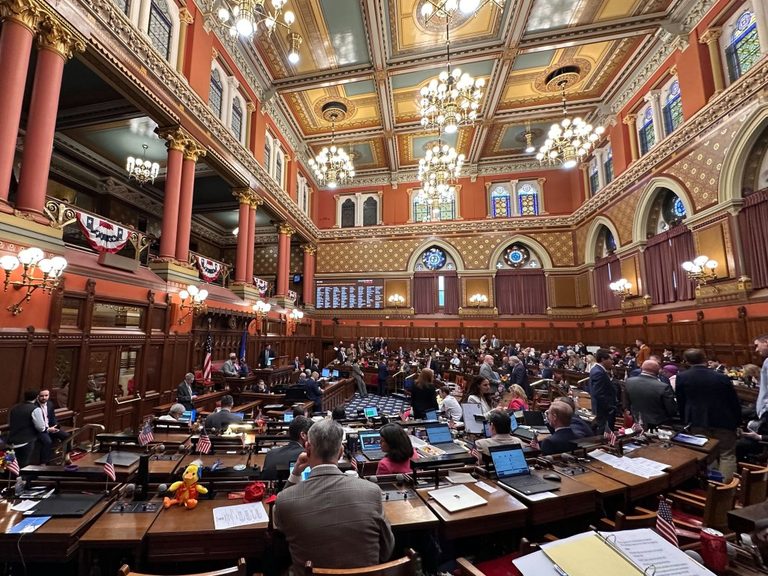
Connecticut’s budget office warns that the state’s sizable pandemic‑era surpluses are disappearing fast, leaving little room for the tax‑cut proposals championed by many local leaders for the 2027 General Assembly session.
Federal aid runs dry, reserves shrink
Since 2020, Connecticut relied heavily on $4.2 billion in emergency federal assistance from the Coronavirus Relief Fund and the American Rescue Plan Act. Those funds helped offset spending caps that stripped $1.8 billion a year from education, health care and other core services. By late 2025 the aid was largely exhausted, and the state’s rainy‑day fund—now a record $4.5 billion—faces depletion if a recession deepens.
Moody’s chief economist Mark Zandi recently called the national economy “uncomfortably close” to recession, citing high oil prices, inflation and ongoing geopolitical tensions. Connecticut’s own data show a sharp rise in residents losing federal nutrition benefits and a surge in households unable to meet a basic survival budget.
Tax‑cut proposals under pressure
Despite the fiscal strain, several advocacy groups and legislators continue to push for tax relief aimed at low‑ and middle‑income families. Connecticut Voices for Children, the United Way of Connecticut and more than half of the current General Assembly support a new state income‑tax credit for families with children. The Connecticut Project is also promoting a renters’ credit.
Analysts estimate the child‑tax credit would cost $350 million to $400 million annually, while the renters’ credit could range from $200 million to $575 million. By contrast, Republican proposals to cut income‑tax rates would cost the state nearly $1 billion each year by 2028.
Raising taxes on the wealthy as an alternative
Given the shrinking surplus, many policy experts argue that financing these credits will require new revenue. Connecticut Voices for Children’s executive director Emily Byrne says the state must “ask the wealthy to pay their fair share.” A coalition called Connecticut For All, representing over 60 faith, labor and civic groups, echoes that sentiment, urging lawmakers to consider increasing taxes on millionaires and billionaires.
Recent polling commissioned by the Connecticut Project shows strong public backing: 73 % of respondents support a renters’ credit, 70 % favor a child‑based credit, and 76 % back raising taxes on the richest residents. The poll’s methodology, conducted by the Survey Lab at Wesleyan University, reflects a broad cross‑section of likely voters.
Political dynamics
Governor Ned Lamont and Republican gubernatorial contender Ryan Fazio—both from affluent Greenwich—warn that higher taxes on the wealthy could trigger an exodus of high‑income households. Lamont’s administration has framed its fiscal approach as “more taxpayers, not more taxes,” emphasizing growth through attracting businesses rather than raising rates.
House Minority Leader Vincent J. Candelora (R‑North Branford) argues that legislators have other tools to fund relief without burdening high earners, underscoring the partisan divide over the best path forward.
What’s next?
The General Assembly is set to convene on Jan. 6, 2027. Lawmakers will need to decide whether to fund the proposed credits with new revenue, dip further into reserves, or abandon the cuts altogether. The outcome will shape Connecticut’s ability to protect essential services while addressing the affordability crisis facing families across the state.
Original reporting: The Connecticut Mirror — read the source article.