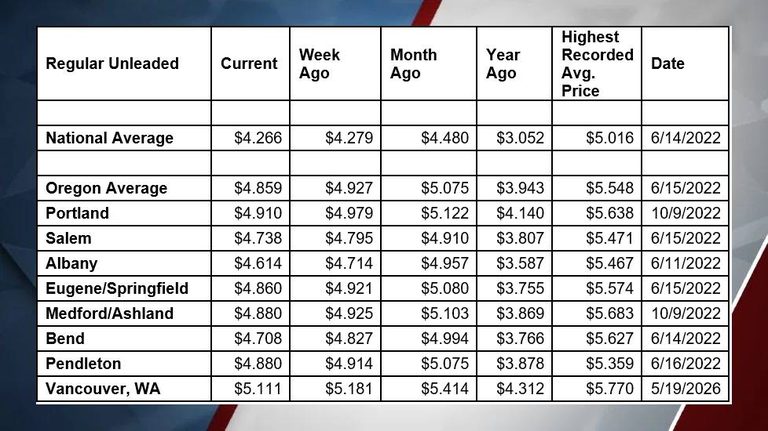
Portland, Oregon – Drivers across the state saw a modest easing of pump prices this week, according to the latest report from AAA Oregon/Idaho. The average price for regular gasoline in Oregon slipped seven cents to $4.86 per gallon, while the Bend area experienced a larger twelve‑cent decline, bringing its average to $4.71.
National context and crude‑oil influence
On a national level, the average price for regular gasoline edged down one cent to $4.27 per gallon. The modest decline comes despite West Texas Intermediate (WTI) crude oil hovering around $100 a barrel, a level driven by ongoing geopolitical uncertainty in the Strait of Hormuz and the broader conflict with Iran.
Marie Dodds, public affairs director for AAA Oregon/Idaho, warned that “geopolitical events and uncertainty continue to put intense pressure on crude oil prices. For now, gas prices are declining in most states, but at some point, rising crude oil prices will likely translate into higher pump prices.”
Historical price comparison
Gasoline prices remain well above pre‑conflict levels. On February 28, the day the United States and Israel launched airstrikes against Iran, the national average was $2.98 per gallon and Oregon’s average was $3.92. Since the conflict began, WTI prices have swung between $68 and nearly $113 per barrel. For reference, crude was $67 a barrel on February 27, the day before the conflict started.
In Oregon, the average price for regular gasoline began 2026 at $3.42 per gallon. The highest price recorded this year so far was $5.353 on May 20, while the lowest was $3.33 on January 20. The state’s all‑time high sits at $5.548, set on June 15, 2022.
Supply, demand and seasonal factors
U.S. gasoline demand rose to 8.98 million barrels per day for the week ending October 16, up from 8.41 million the previous week and slightly above the 8.45 million barrels per day recorded a year ago. Domestic gasoline supply fell from 208.3 million barrels to 205.3 million barrels in the same period, while gasoline production increased from 9.23 million to 9.75 million barrels per day.
Seasonal shifts also play a role. The transition from summer‑blend to winter‑blend fuel, which begins in September, typically lowers pump prices because winter‑blend fuel costs less to produce. Oregon can sell winter‑blend fuel starting September 15, though California continues to require summer‑blend fuel through October 31, keeping West Coast prices relatively higher.
Broader energy landscape
Crude oil remains a dominant component of gasoline costs, accounting for roughly 52 % of the price per gallon, according to the U.S. Energy Information Administration (EIA). The United States continues to be a top global oil producer, averaging about 13.27 million barrels per day for the week ending October 16, with production often exceeding 13.5 million barrels per day since October 2024.
Internationally, about 20 % of the world’s oil and refined products flow through the Strait of Hormuz. Recent attacks on maritime traffic in the strait have heightened concerns about supply disruptions, which can push crude prices higher and, in turn, affect pump prices.
State‑by‑state snapshot
Oregon is one of 39 states and the District of Columbia reporting lower gasoline prices this week. Ohio saw the largest week‑over‑week increase at 36 cents, while California recorded the biggest decline at 15 cents. California’s price remains the highest in the nation at $5.99 per gallon, whereas North Carolina offers the cheapest gasoline at $3.46 per gallon.
No state posted an average below $2 per gallon this week, a threshold last seen on January 7, 2021, when Mississippi and Texas fell below that level.
Original reporting: KTVZ (Central Oregon) — read the source article.