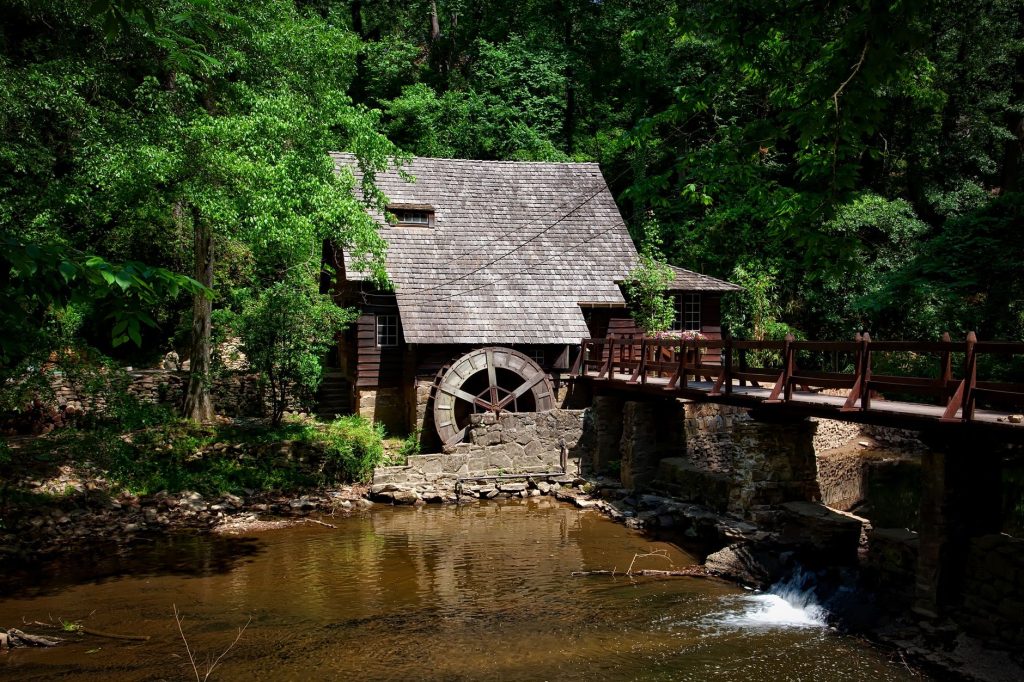
The millstone at Haines Mill still sits where it has for two centuries, worn smooth by water and grain and time. The mill itself closed to regular milling long ago, but the building endures along Trout Creek Parkway, and the trail that winds past it remains one of the more quietly rewarding walks in Allentown — less trafficked than Lehigh Parkway, less manicured than Cedar Beach, and almost entirely off the radar of anyone who moved to the area in the last decade.
Haines Mill County Park anchors the northern end of the Trout Creek Parkway corridor. Lehigh County owns the mill structure, a late-eighteenth-century stone building that looks exactly like what it is: a working grist mill preserved at the point of productive obsolescence. The museum inside opens on weekend afternoons in warmer months — admission runs just a dollar or two for adults, less for kids — and a volunteer docent will walk visitors through the mechanics of the operation with the kind of detail you only get from someone who has been explaining this to strangers for twenty years. The wooden gears are original. The smell of old wood and stone dust is not something a replica can manufacture.
But most people come for the trail, not the mill. The path follows Trout Creek south through a narrow wooded corridor that feels surprisingly removed from the surrounding neighborhood of West Allentown. The creek runs clear over flat limestone shelves in dry months, and in early spring it moves fast enough to drown out road noise entirely. There are benches at irregular intervals. There is almost no signage, which either suits you or doesn’t.
The full Trout Creek Parkway corridor runs roughly two miles between Haines Mill Road and the southern terminus near Tilghman Street, though the trail connects to additional segments and road crossings depending on how far a walker wants to push. The surface is unpaved and uneven in stretches — roots cross the path, and low spots collect mud after rain. It rewards trail runners and casual walkers equally, as long as expectations about surfaces are calibrated accordingly. Dogs on leashes are common; the creek provides a natural stopping point for them.
Fall is the obvious draw. The canopy along the creek corridor is dense enough that late October color concentrates into something almost theatrical — maples close to the water go orange and red while the path stays shaded until mid-morning. Weekday mornings between September and November see the lightest foot traffic, which is when the place earns whatever reputation it has among people who come back.
Parking at Haines Mill Park is free and limited to a small lot off Haines Mill Road, on the west side of Allentown. The park sits in a residential area with no commercial corridor nearby, so there is nothing to grab on the way in or out without planning. That lack of infrastructure is part of what keeps the crowd manageable. There is no coffee cart, no bike rental, no food truck on weekends. Bring water.
The mill doesn’t compete with anything. It predates the city around it by a generation, and the parkway that follows the creek was designed to stay raw in ways that Hamilton Street parks were not. That combination — functional historic structure, unpaved trail, real water — is harder to find in an urban county than it should be, which is probably reason enough to visit before someone installs interpretive panels and a parking kiosk.