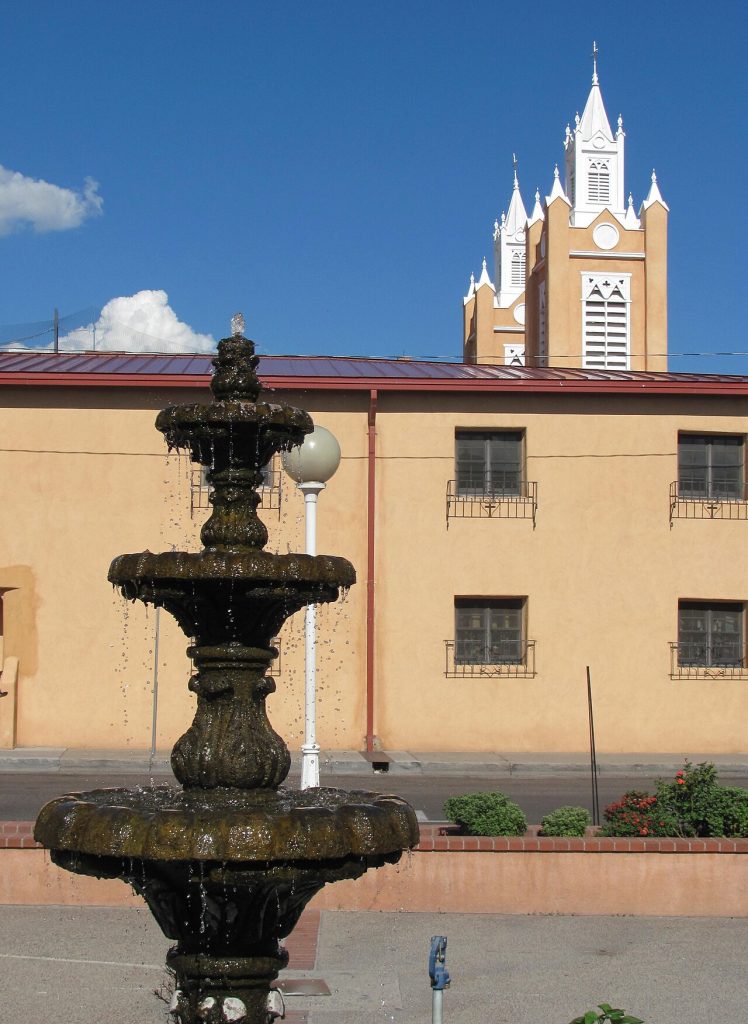
San Felipe de Neri Church was built in 1793 — and even that isn’t the original. The first adobe structure on this plot in Old Town Plaza collapsed in 1792 after a brutal rainy season, less than a century after the parish was first established in 1706. What replaced it has outlasted empires, territorial governments, and every adjacent real estate trend since the Rio Grande was a trade route.
On a rainy Tuesday in October, the plaza in front of the church is almost quiet. The curio shops haven’t opened yet. A few pigeons work the wet flagstones. Inside the low wooden gate at the church entrance, a woman in a rain jacket pauses to read the bronze historical marker with the slow attention people give things that actually matter. This is not the hurried tourist mode. This is Albuquerque in the off-hours, and the church earns it.
The exterior is modest by any cathedral standard — whitewashed adobe walls, twin towers with rough wooden crosses, a façade that looks like it was designed to survive the desert rather than impress a bishop. That restraint is the point. The building reads as permanent in a way that poured concrete rarely does. Step through the heavy wooden doors and the interior is cool, dimly lit, and immediately calm. Pale walls, dark vigas overhead, painted santos in the side niches. The altar is gilded but not gaudy. Sunlight, when it manages to cut through the clouds on a day like this, reaches the pews in long narrow slabs.
The churchyard running along the north wall holds some of the oldest marked graves in the city. Dates from the 1800s are still legible on some stones. The garden is small and tended, with a statue of the Virgin under a sheltering portal. It’s the kind of space that invites a few minutes of sitting, even for people with no particular religious affiliation. The silence is specific — not empty, but full of age.
What makes San Felipe de Neri different from a generic historic church visit is context. It still functions as an active parish. Mass is said here every week. Weddings happen here. The building isn’t preserved in amber; it’s in continuous use by the same community whose ancestors were buried in that north wall garden. That continuity is rare enough to notice.
Admission is free. The church is generally open to visitors during daylight hours, though specific access may shift around services — a quick check of the parish schedule before visiting is worth it. Photography is permitted in the exterior and grounds; inside, visitors are asked to be respectful during active services, which is reasonable.
Parking around Old Town can be tight on weekends in the summer, but a Tuesday morning in the rainy season, the streets near the plaza are half-empty. That’s probably the best time to see it: when the gift shops are quiet and the light through the windows is gray and even, and the building can be taken seriously for what it is — not a backdrop for photos, but the oldest continuously operating parish in New Mexico, doing exactly what it has been doing for more than three hundred years.