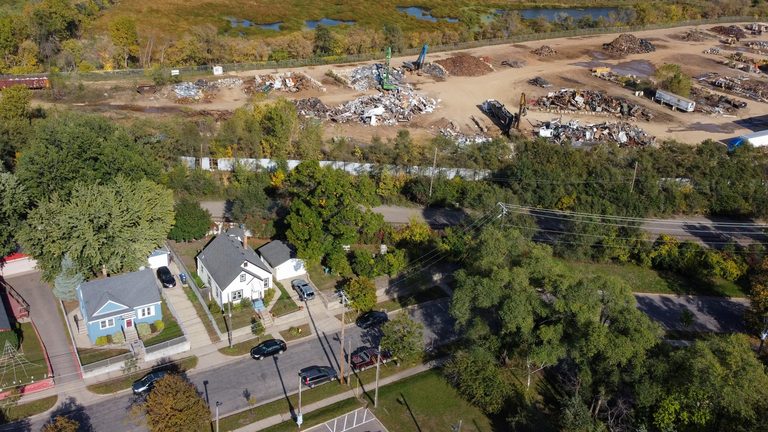
Jazzalyn Baker, a mother of three, moved to Southport on St. Paul’s West Side four years ago. Since then, her migraines have become a daily ordeal and her son’s asthma attacks have increased. “I find myself going to urgent care constantly,” she told the Sahan Journal.
Concerned residents joined the West Side Community Organization for a guided tour of Southport on a sunny October afternoon, inviting state, county and city officials to see the conditions firsthand. The neighborhood sits beside the Mississippi River, near the St. Paul Downtown Airport and an industrial park accessed only via Robie Street. Heavy diesel trucks serving the park and a large metal‑recycling scrapyard regularly back up the narrow road, creating traffic congestion, noise and exhaust fumes.
Industrial legacy and current health worries
Southport’s history includes the former West Side Flats, a once‑vibrant Mexican‑American community displaced in the 1960s to make way for the Riverview Industrial Park. Today, the area is dominated by the EMR‑owned metal‑scrap facility that acquired the local Northern Metals operation. Northern Metals previously faced state‑ordered shutdowns for violations at a North Minneapolis site, raising community fears that similar problems could recur.
Residents such as Chloe Krenz describe daily exposure to idling trucks: “We’re dealing with the noise, exhaust and air pollution that comes from all these trucks idling.” In addition to diesel emissions, stray metal parts from freelance scrappers litter the streets, puncturing tires and creating safety hazards for pedestrians.
Community organizing and city response
Community organizer Miguel Brito, who grew up in the neighborhood and attended Our Lady of Guadalupe Catholic Church, has been gathering data on air‑quality concerns. “They’re the ones who have the solutions. They’re the ones who deal with this everyday,” he said, emphasizing resident‑led ideas for improvement.
The West Side Community Organization is collecting suggestions to improve road safety, add pedestrian pathways and explore a second access point for the neighborhood. They have also drafted a dust‑control ordinance now moving through the St. Paul City Council committee process, which appears to have broad support among council members.
City officials, along with the St. Paul Port Authority and Ramsey County, have been briefed on the proposed measures. “We’re going to create levers of accountability,” Brito said, noting that the ordinance would give the city clearer tools to enforce dust‑reduction standards on industrial sites.
Dialogue with the scrapyard
Earlier this month, residents delivered a letter to EMR plant managers requesting a meeting to discuss traffic, noise and pollution concerns. While the company has not yet responded, organizers remain hopeful. “We hope that we hear back from them. It’s in good faith. We want to have conversations with people,” Brito said.
City staff have indicated willingness to facilitate a constructive dialogue, emphasizing that the goal is not antagonism but collaborative problem‑solving to protect families and preserve the neighborhood’s livability.
Next steps
The dust‑control ordinance is expected to be voted on at the next full council meeting. If adopted, it would empower the city to require regular monitoring of particulate emissions and impose penalties for violations. Residents also hope the council will consider funding for additional traffic engineering studies to alleviate truck backups on Robie Street.
For now, Southport families continue to advocate for cleaner air and safer streets, trusting that local government will act in the best interest of the community’s health and well‑being.
Original reporting: Sahan Journal — read the source article.