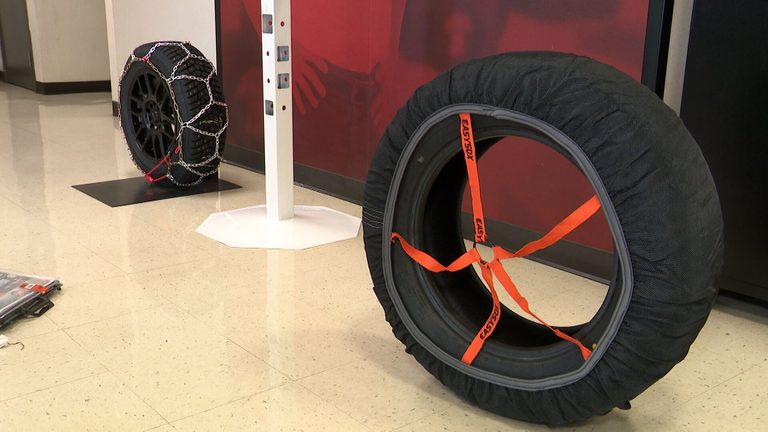
Early snowfall in the Sierra foothills has drivers in Reno and the surrounding mountains looking for reliable traction on icy roads. Local tire retailer Les Schwab, located off Kietzke Lane, is promoting snow socks as a user‑friendly alternative to traditional tire chains.
What are snow socks and how do they work?
Snow socks are fabric‑based traction devices manufactured by companies such as AutoSock. According to the maker, the material wicks away water and grips directly to the snow and ice layer, providing a steady hold without the clanking metal links of a chain.
“It’s simply like stretching a sheet over a bed,” explains Jordan Savelli, assistant manager at Les Schwab. “You just stretch it over the tire, drive a little farther and then stretch the next one.”
Easier installation and reduced risk of damage
Savelli notes that chains require careful alignment of each link, which can be time‑consuming and risky. “If you install a chain on an incorrect vehicle, it can damage the brake lines and cause more of an issue, especially on the snow,” he says.
Snow socks, by contrast, wrap tightly around the tire, minimizing the chance of contact with brake components or other parts in the wheel well. The trade‑off is durability: the fabric design is not intended for unlimited use. Savelli advises, “I would say it would be safe to run the sock around no more than five times.”
Regulatory approval in Nevada and California
Both Nevada and California allow snow socks when they meet the same chain‑required standards. Ruth Loehr, public information officer for the South Lake Tahoe office of the California Highway Patrol, confirms that snow socks are approved for the common R2 chain requirement and also meet the rarer R1 and R3 standards.
Consumers should verify that the product’s packaging shows approval by Caltrans or the National Highway Traffic Safety Administration (NHTSA). Loehr adds, “I have not seen them to not work. They have been efficient every time I’ve seen somebody use them.”
Practical considerations for drivers
Before purchasing, drivers should consult their vehicle’s owner’s manual to confirm whether chains or snow socks are permitted. While snow socks are generally priced similarly to chains, availability is widespread at tire shops and auto parts stores.
At chain‑control checkpoints, the final decision rests with the checkpoint personnel. Loehr emphasizes, “It’s all about safety and whether you’ll make it through chain control.”
Bottom line for Reno motorists
Snow socks provide a straightforward, low‑maintenance option for winter traction that complies with state regulations and reduces the risk of brake‑line damage. For Reno drivers seeking a quick solution to early‑season snow, they are a viable choice worth considering.
Original reporting: 2news.com — read the source article.