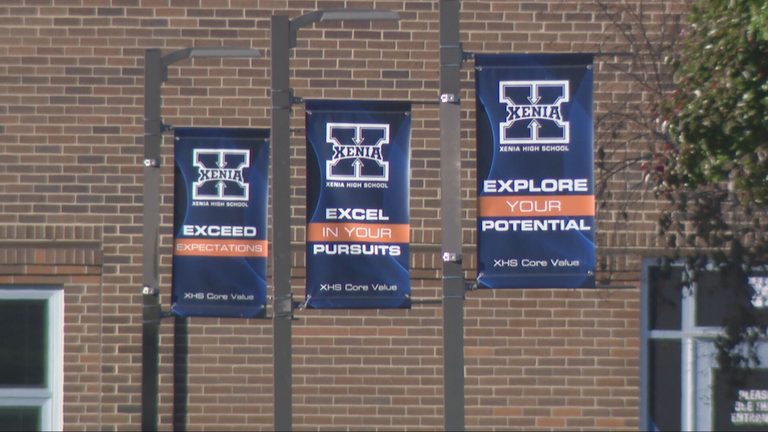
On Monday, roughly thirty students from Xenia High School left their classrooms in a coordinated walk‑out to voice opposition to the recent removal of a mural that portrayed scenes from Palestine. The protest was organized after a member of the Xenia School Board, Tyler Scott, declared the artwork “too political” and ordered its removal in accordance with district policy and state guidelines.
Board’s rationale
Board member Scott explained that the mural presented a political stance, regardless of the artists’ intentions, and therefore violated the school’s policy on political expression. He said a parent had alerted him to the mural on Thursday, prompting the superintendent to review the piece. “That is a political stance, regardless of the intention, and that is not acceptable on our walls, per our policy, and per state guidelines,” Scott told News Center 7.
Student response
Students gathered in the hallway and briefly left the building, emphasizing their First Amendment right to peaceful assembly and free expression. A sophomore confirmed that two additional murals in the art room had also been taken down, though the district is still verifying that claim.
“We’re just trying to have our voices heard,” one participant said. “Art is a way to start conversation, not to silence it.” The walk‑out lasted only a few minutes, and school officials reported that safety and normal operations remained the top priority throughout the event.
District statement
The district released a statement acknowledging the students’ right to peaceful protest while reaffirming its commitment to maintaining a safe learning environment. “Public schools serve as important spaces for civic learning, and the district respects our students’ First Amendment rights to peaceful assembly and free expression,” the statement read.
Community reaction
Local residents and parents have expressed mixed feelings. Some support the board’s decision, arguing that public schools should remain neutral on contentious geopolitical issues. Others worry that removing the mural stifles open dialogue and may set a precedent for censoring artistic expression.
Board member Scott reiterated his concern about potential anti‑Semitic interpretations of the mural, stating, “I’m just concerned that we have so many students that feel so strongly about a mural depicting potential anti‑Semitism, and that is concerning to me. And it’s not their fault. I think there’s a lot of misunderstanding here.” He added that the attention the mural generated underscored why it should not remain on school walls.
Looking ahead
The district has not indicated whether it will replace the removed artwork with new pieces or adopt a different policy for future student‑created displays. School administrators say they will continue to engage with parents, students, and community members to ensure that any future art projects comply with established guidelines while fostering an environment where students can express themselves responsibly.
As the conversation continues, the Xenia community watches closely to see how the balance between free expression and school policy will be navigated in the coming months.
Original reporting: WHIO-TV Dayton (local) — read the source article.