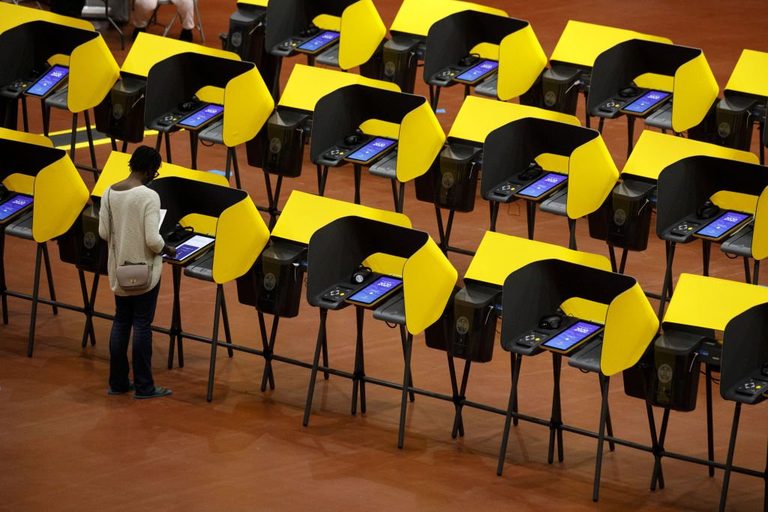
As early voting for the November midterm elections begins, social‑media posts from voters in Kansas, Ohio, South Carolina, Tennessee and Texas claim that touchscreen voting machines flipped their choices. The complaints have sparked fears of a partisan rigging effort, especially among Democratic voters.
Officials attribute issues to human error and equipment calibration
Election administrators say the problems are almost always the result of understandable human error or a simple screen miscalibration that can be quickly fixed. “Almost all of the claims of vote flipping are understandable human error,” said David Becker, executive director of the Center for Election Innovation and Research. He added that disinformation purveyors often seize on well‑meaning concerns to sow doubt.
In Williamson County, Tennessee, election administrator Chad Gray reported no discrepancies in the voting equipment. “If problems or questions do arise, people from each party will examine the devices and make sure they are working properly,” he said.
Mark Goins, Tennessee’s elections coordinator, described the incidents as “unintended touches” rather than vote‑flipping. Similarly, Staci Decker, elections administrator in Kendall County, Texas, said the issue is typically a voter tapping the wrong part of the box or pressing too hard, causing the screen to become miscalibrated. She noted that staff recalibrate the screens every few days to maintain accuracy.
Local anecdotes illustrate the confusion
Stella Parton, sister of the late country singer Dolly Parton, posted on Facebook that she had to go back three times to correct her vote because the machine kept defaulting to Republican Sen. Marsha Blackburn. She urged fellow voters to persist despite the inconvenience.
Another voter recounted a video in which his mother‑in‑law’s attempts to vote for Democratic candidates in Kendall County, Texas, were repeatedly recorded as Republican selections. The voter ultimately succeeded but concluded that “people are jacking with our elections.”
Election officials emphasize safeguards and audits
Across the nation, officials stress that touchscreen voting machines print a paper record for voter review before the ballot is cast. The machines used in the reported incidents are ExpressVote devices from Election Systems & Software (ES&S). Katina Granger, senior manager of public relations for ES&S, said the company has not been made aware of any widespread issue this cycle and advises voters who encounter problems to seek assistance from poll workers.
Most jurisdictions also conduct post‑election audits that involve a manual hand count of a sample of paper ballots, providing an additional layer of verification.
Poll data shows lingering distrust
An AP‑NORC poll cited in the original report indicates that many Democrats have lost trust in election results over the past four years, with concerns about presidential interference remaining high. While the poll reflects a broader sentiment, officials reiterate that the reported touchscreen glitches do not constitute evidence of systematic fraud.
Election officials continue to encourage voters to take their time, review their selections on the printed paper record, and ask poll workers for help if needed. By addressing user error and maintaining rigorous testing and auditing procedures, they aim to preserve confidence in the voting process.
Original reporting: Richardson, TX News (HLL/CB) — read the source article.