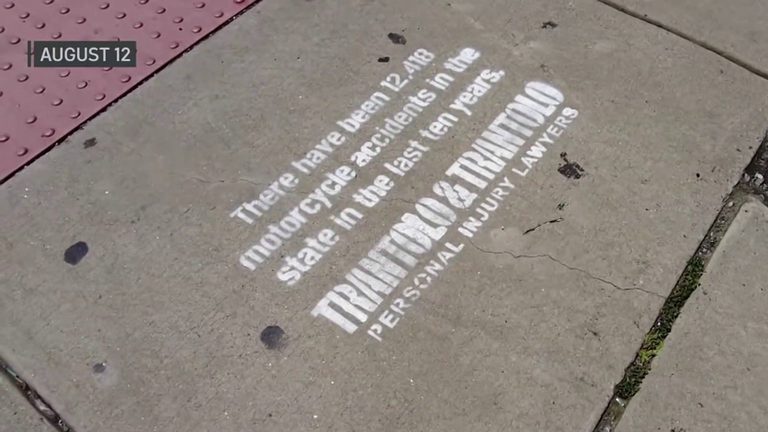
Hartford law firm Trantolo & Trantolo is preparing to sue the City of Hartford and Mayor Arunan Arulampalam after the municipality issued a citation for placing 28 spray‑chalk advertisements on city sidewalks. The firm argues the citation infringes on its First Amendment rights.
Background of the chalk campaign
In August, the firm hired an outside marketing company to temporarily display road‑safety statistics on sidewalks throughout Hartford, including near Bushnell Park. Each message was signed by Trantolo & Trantolo and carried the tagline, “Hartford has a serious road safety problem. That is the story we set out to tell.”
The campaign drew mixed reactions. Some residents praised the creative approach to public‑safety awareness, while others claimed the chalk could distract pedestrians.
City response and citation
Mayor Arulampalam responded at the time, stating, “If a young person did this in the City of Hartford, we would call it graffiti, and I don’t believe that a law firm should be treated any differently.” He added that residents “don’t want to walk through the streets of Hartford or Bushnell Park and think about slip and falls.”
Following the mayor’s comments, the city filed a grievance for improper attorney advertising, describing the chalk as “undoubtedly designed to distract pedestrians.” Hartford Police also issued a fine under a city ordinance that prohibits placing posters, placards, signs, or advertising devices without the property owner’s written consent.
Law firm’s legal stance
Nearly two months later, Trantolo & Trantolo notified the city and the mayor that it is considering legal action, asserting that the citation violates free‑speech protections. Attorney Mario Cerame wrote, “Commercial or ideological, free speech requires the right reason and the right rule.” Lead attorney Keith Trantolo told NBC Connecticut, “It is not for a mayor, a public figure, to be opining about personal injury advertisements in a way that suggests he is the voice of the public. It is, in our opinion, a violation of the First Amendment.”
When asked why the firm did not seek prior permission, Scott Trantolo explained, “We had hired a national company to do this. We thought we had dotted all of our I’s and crossed our T’s. Part of raising awareness is getting people to pay attention.”
Legal arguments about sidewalk authority
The firm contends that Hartford’s ordinance does not explicitly mention sidewalks, and therefore the city’s enforcement was not neutral. “Each town has every right to make its own ordinance to say no one can chalk anything on our sidewalks, including a young boy or girl wanting to draw whatever they desire on their driveway or a public sidewalk, which I think probably goes a little too far,” Keith Trantolo said.
Mayor Arulampalam replied, “Trantolo & Trantolo was cited for graffiti, didn’t deny it was them who was responsible for the graffiti, and instead of accepting responsibility, they chose to threaten to sue me in my personal capacity for doing my job. I urge them to take accountability for their actions and move on.”
Implications for local free‑speech and advertising rules
The dispute highlights the tension between municipal code enforcement and First Amendment protections for commercial speech. If the firm proceeds, the case could clarify whether sidewalk advertising falls under existing signage regulations or enjoys broader free‑speech safeguards.
City officials have not indicated whether they will modify the ordinance pending litigation. The outcome may affect how local businesses and advocacy groups use public spaces for messaging in Hartford and potentially across Connecticut.
Original reporting: NBC Connecticut — read the source article.