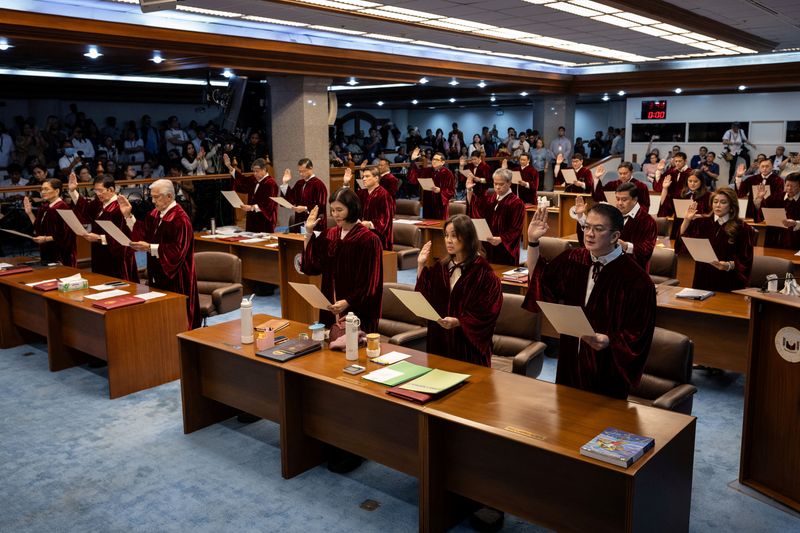
In the Philippines, President Ferdinand Marcos Jr. has called on the Senate to resume its legislative duties as a political impasse has stalled crucial legislative work ahead of a scheduled congressional break. The deadlock in the Senate, marked by a growing divide between majority and minority factions, has halted plenary sessions for two consecutive days.
President Marcos expressed his concern, stating, “It’s a very, very sad situation to have to watch. The country needs assistance. People need assistance. How can we provide that assistance without the proper legislation to back it up?” The government is considering submitting a supplemental budget to address rising energy prices, but the legislative gridlock poses a significant hurdle.
Senate Leadership in Disarray
The impasse began when the minority bloc called for the resignation of Senate President Alan Peter Cayetano. The situation escalated when Senator Ronald “Bato” dela Rosa, who is wanted by the International Criminal Court (ICC), reappeared to cast a decisive vote for Cayetano’s leadership. Dela Rosa’s involvement has been controversial due to his association with former President Rodrigo Duterte’s administration and the ICC charges against both him and Duterte.
Senate President Cayetano, a close ally of the Duterte family, has faced calls for his resignation. In response, he stated that if the minority bloc secured more support, they could vote him out. Cayetano’s office has yet to comment directly, but he mentioned in a Facebook video that the Senate is ready to address priority bills, though he claims the executive branch is not prepared.
Impact on the Nation
The political stalemate has broader implications for the Philippines. Political science professor Jean Encinas-Franco noted that the Senate should be a stable political body, not a spectacle, as the current situation sends negative signals to investors. The Financial Executives Institute of the Philippines highlighted the costs of this “institutional paralysis,” noting that stalled programs, delayed investments, and underserved communities are the consequences of the ongoing gridlock.
As the Senate remains in disarray, the public faces rising costs and uncertainty. The call for legislative action is urgent, with the potential for significant impacts on the nation’s economy and the well-being of its citizens.
Original reporting: Appleton, WI News Feed (HLL/CB) — read the source article.