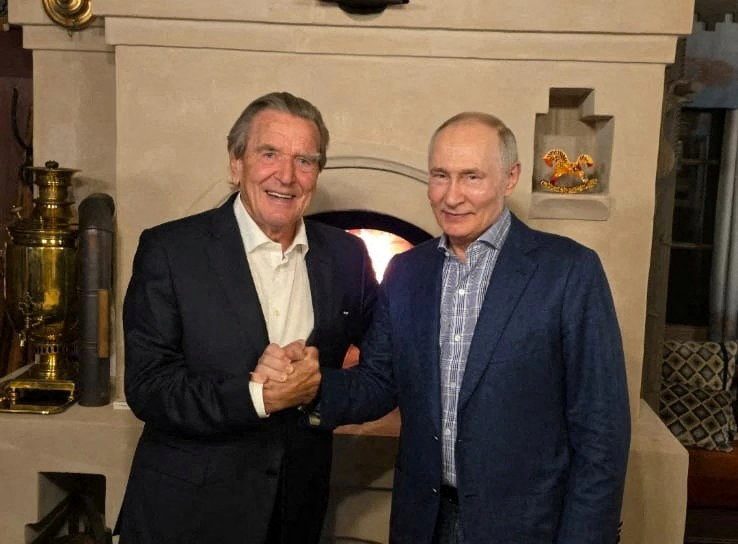
Berlin – Chancellor Friedrich Merz expressed strong outrage on Friday after former Chancellor Gerhard Schroeder traveled to Vladimir Putin’s residence to mark the Russian president’s 74th birthday. A government spokesperson said Merz described the visit as “downright immoral” given the ongoing suffering caused by Russia’s invasion of Ukraine.
Background on Schroeder’s Russian ties
Schroeder, who led Germany from 1998 to 2005, has long faced scrutiny over his connections to Russian business interests. After leaving office, he chaired the shareholders’ committee of the Nord Stream pipeline project and later held senior roles at Russian oil giant Rosneft. Earlier this year, Putin publicly named Schroeder as his preferred interlocutor for new European security talks, a proposal that the European Union and the Merz government promptly rejected.
Domestic criticism
The visit also drew condemnation from within Schroeder’s own Social Democratic Party (SPD). Party co‑leader and finance minister Lars Klingbeil called the appearance “completely unacceptable” in light of the human cost of the war in Ukraine, according to the Süddeutsche Zeitung. Schroeder, 82, and his wife So‑Yeon Schroeder‑Kim did not respond to Reuters requests for comment.
Recent Russian appointments
In addition to his historic pipeline role, Schroeder recently joined the supervisory board of Hyperglobus, a Russian retailer spun off from Germany’s Globus Holding, which operates more than 20 supermarkets in Russia. Critics argue that these positions demonstrate an ongoing willingness to engage with Russian enterprises despite Western sanctions.
Merz’s response
Merz’s office reiterated that Putin bears sole responsibility for the war in Ukraine and that the resulting civilian casualties and family separations constitute “immeasurable suffering.” The chancellor’s statement underscored the German government’s stance that any celebration of Putin’s leadership is morally indefensible while the conflict continues.
International context
Germany’s firm condemnation aligns with broader NATO and EU positions that seek to isolate Russia diplomatically and economically. While the German coalition, led by Merz’s conservative party, continues to enforce sanctions, the episode highlights lingering divisions within German politics over how to handle former officials who maintain close ties to Moscow.
As the war in Ukraine drags on, the episode serves as a reminder that personal relationships with Russian leaders remain a flashpoint in German domestic and foreign‑policy debates.
Original reporting: Appleton, WI News Feed (HLL/CB) — read the source article.