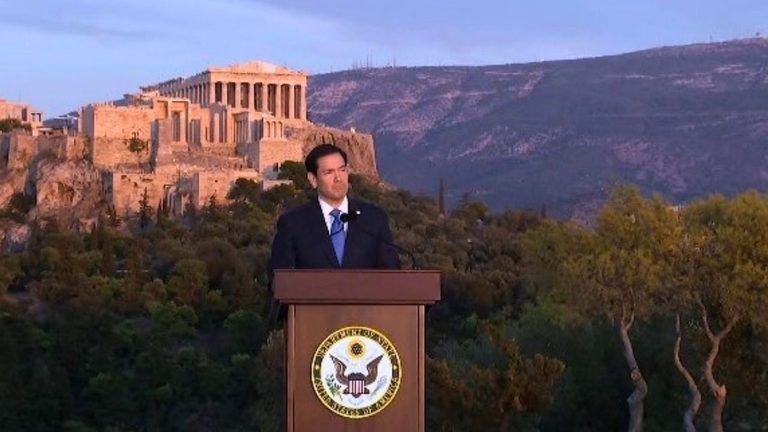
During a visit to Athens on Oct. 7, U.S. Senator Marco Rubio used the historic Pnyx—the birthplace of direct democracy—to argue that Western nations have eroded their power by treating nationalism as a taboo. Speaking before a small audience of diplomats and local officials, Rubio linked national loyalty to the ancient Greek virtues of duty, sacrifice, and civic courage that have shaped Western civilization.
Nationalism as a Moral Good
Rubio said, “Nationalism became a dirty word, so we tore down our monuments, condemned our own history, and taught our children to be ashamed of the countries they inherit.” He added that this cultural shift has led to open borders, outsourced industry, and a weakened military.
Rejecting the notion that putting a nation’s interests first is selfish, Rubio warned that “it has become fashionable today to believe that enlightened foreign policy means prioritizing the global community over one’s own people.” He cited the ancient Greeks, who “knew there was nothing selfish or wrong about loyalty to your nation, nor in fighting to defend its interests above all else.”
Sovereignty Over Global Bureaucracy
Rubio also criticized the transfer of authority from national governments to international institutions, describing it as “outsourcing more of our sovereignty, transferring our decisions to global bureaucracies far beyond the reach of our control.” He framed the next decade as a crossroads that will determine whether the West remains a global leader or slides into “atrophy, servitude, and decline.”
Under President Donald Trump, Rubio said, the United States has already chosen “the unapologetic pursuit of national power.” He defined that pursuit as taking back control of critical supply chains, reindustrializing the economy, rebuilding defense, and competing for dominance in emerging technologies.
European Shifts and New Partnerships
Rubio pointed to signs of change in Europe, noting increased defense spending, expanded manufacturing, and new partnerships. “We believe Europe can awaken from its long slumber and rekindle the fire that was lit here millennia ago,” he said.
During a joint appearance with Greek Foreign Minister Giorgos Gerapetritis, Rubio called Greece a “strong and model NATO ally” and announced a memorandum of understanding to strengthen counter‑terrorism information sharing between U.S. and Greek law‑enforcement agencies.
Faith and Heritage in the Western Narrative
Rubio wove Christian heritage into his remarks, referencing the Christian martyr who refused to betray his faith, the patriot who gave his life for his country, Saint Thomas More, the Battle of the Alamo, and the Declaration of Independence’s pledge of “our Lives, our Fortunes and our sacred Honor.” He contrasted this legacy with extremist movements that glorify death, stating, “Our heroes do not worship death.”
The speech echoes themes Rubio raised earlier at the Munich Security Conference, emphasizing that Western civilization is bound by shared history, Christian faith, culture, language, and the sacrifices of forebears.
Local Relevance
Rubio’s remarks arrive amid ongoing debates in Texas over the role of Christianity in public life, including recent coverage of the President’s Religious Liberty Commission and local Christian rallies in Dallas. While the Athens address did not call for an established religion, it underscores the administration’s focus on national sovereignty, economic strength, and cultural heritage—issues that resonate with many Texas voters.
Rubio’s call for a renewed embrace of nationalism aligns with the Trump administration’s broader agenda of “America First” policies, including efforts to protect domestic industry, secure borders, and maintain a robust defense posture.
Original reporting: The Dallas Express — read the source article.