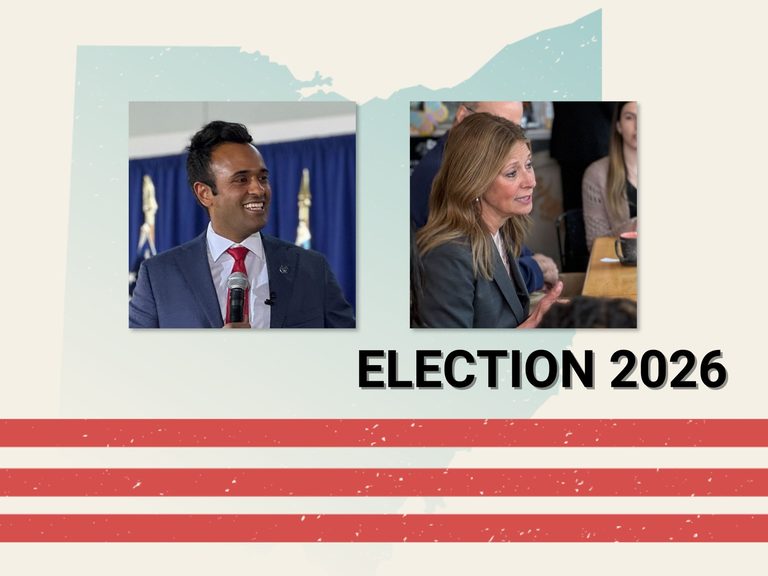
Ohio’s 2026 gubernatorial race is heating up on college campuses. Democrat Amy Acton and Republican Vivek Ramaswamy have each visited a series of universities, career centers and off‑campus venues across the state since January, seeking to connect with younger voters and showcase their platforms.
Campus stops to date
According to the candidates’ own websites and social‑media feeds, Acton has made at least eight appearances at or near higher‑education institutions. Her most frequent stop has been Ohio University in Athens, where she has spoken twice this year. Ramaswamy, by contrast, has logged at least five campus‑area visits, including a June appearance at the Buckeye Career Center’s New Philadelphia campus and a September 26 rally titled “Bobcats for Vivek” at an off‑campus bar in Athens.
Targeting both bases and swing areas
Many of the stops have taken place in regions that strongly favor each candidate’s party. Acton’s Ohio University visits occur in a city and county that backed Kamala Harris over President Trump in the 2024 presidential election. Ramaswamy’s Buckeye Career Center stop is in a county where voters overwhelmingly supported President Trump two years ago.
Both candidates have also ventured into areas where their party’s base is less dominant. Acton traveled to a career center in rural Gallia County, a district where nearly 80% of voters supported President Trump in 2024. Ramaswamy’s Athens rally placed him in a community that leans Democratic.
What the candidates say
Acton’s campaign spokeswoman, Virginia Schaus, says the governor‑candidate is touring colleges to hear directly from students and educators about “the issues that matter most to them, from access to higher education to affordability.” Ramaswamy’s team has not responded to requests for comment.
Expert perspective on college campaigning
Austin Trantham, an assistant professor at Saint Leo University in Florida who studies the geography of gubernatorial campaigns, notes that college visits are not traditionally a priority for either party because young voters historically turn out at lower rates. He adds that candidates tend to focus on areas with higher voter turnout or strong partisan support.
Nevertheless, Trantham believes campus stops can shape perception. “In our social‑media‑driven campaign environment, the images and content generated by these appearances can reach audiences well beyond the campus itself,” he wrote. He also points out that the lack of comprehensive data makes it difficult to track every campaign stop, as schedules are fluid and details are often released late.
Media coverage and criticism
Ramaswamy’s campus events have attracted more media attention than Acton’s. His April appearance at Ohio State University was reported by WOSU, where audience members “criticized and questioned” his proposals. A July rally at Cincinnati’s Xavier University was met with boos, according to the Cincinnati Enquirer, though both events were hosted by conservative‑leaning student groups.
Ramaswamy’s earlier proposal to consolidate some of Ohio’s public universities sparked controversy. While he has since walked back the plan, the criticism persists. A 501(c)(4) political action committee, Bring Ohio Back Now, has placed billboards near several campuses warning that his consolidation plan could “wipe out Ohio colleges.” The billboards target students at Kent State, Youngstown State, Lorain County Community College, Stark State College, Bowling Green State University, Shawnee State University and Wright State University.
Looking ahead
Both campaigns indicate that more campus visits are planned as Election Day approaches. Acton’s schedule includes additional stops in the northwest and northeast parts of the state, though no specific dates have been announced. Ramaswamy has one more confirmed visit slated for mid‑October.
While college campaigning may not sway the bulk of the electorate, the candidates hope the visibility will resonate with younger voters and their families, reinforcing their messages on student‑loan debt, job prospects and the future of Ohio’s higher‑education system.
Original reporting: Signal Akron — read the source article.