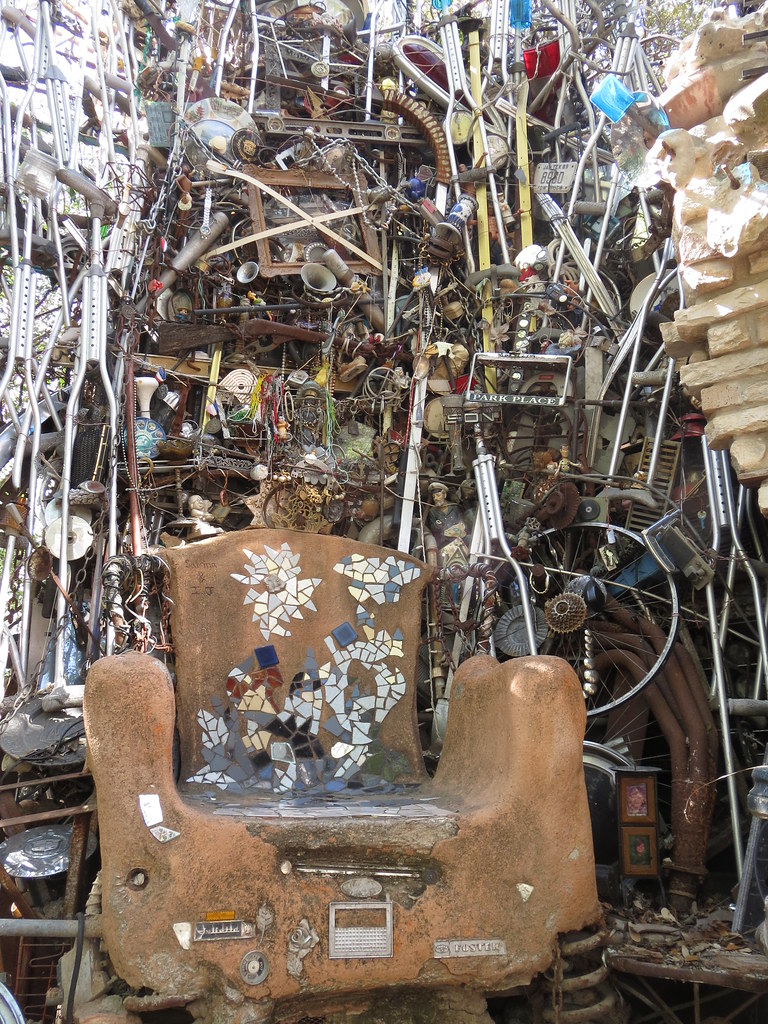
There’s a thirty-foot tower of bicycle wheels, VHS tapes, license plates, and at least three toilet seats visible from the backyard of a house on Lareina Drive in South Austin. This is not a euphemism. Vince Hannemann has been bolting, wiring, and willing this thing into existence since 1988, and the Cathedral of Junk is now somewhere around sixty tons of assembled debris arranged into chambers, archways, and a viewing platform you can actually stand on — provided the man himself is home and in the mood for visitors.
That last part is the first reason to go. The Cathedral operates on a loose, call-ahead system; Hannemann’s number circulates freely online, and if he picks up and says come over, you drive south past the H-E-B on Slaughter and find a perfectly ordinary-looking street where one yard is absolutely not ordinary. Admission is a suggested $1 donation. One dollar. The experience costs roughly the same as a gas station coffee and delivers considerably more to think about on the drive home.
The second reason is that it’s genuinely impossible to photograph well, which is a strange compliment but an honest one. The Cathedral defies the flattening effect of a phone screen. You have to be inside it — ducking through a corridor made of CDs and hubcaps, stepping over a mosaic floor of smashed ceramic — for the scale and the density to register. Some of the objects are recognizable: old televisions, broken toys, car parts. Others are so thoroughly embedded they’ve lost whatever original identity they had. The whole structure operates like a collective unconscious rendered physical.
Third: Hannemann himself, if he’s around. He’s not performative about it. He doesn’t give speeches. But he’ll answer questions in a measured, matter-of-fact way that makes a thirty-foot tower of junk sound like a perfectly reasonable use of three decades. It is, he’ll suggest, essentially a meditation on the way objects accumulate meaning. He’s probably right.
A few practical notes: weekends are easier, but never guaranteed. The structure can handle small groups, not tour buses. Wear closed-toe shoes — this is a sculpture garden made of sharp things. The backyard is not accessible to anyone who can’t navigate uneven terrain. Children generally find it magnificent. Adults who came in skeptical tend to leave quieter than they arrived.
The Cathedral has survived a demolition threat, a city permit battle, and general Austin weirdness for over thirty years. It is not a museum, not a tourist attraction in any commercial sense, and not trying to be either. It is one man’s ongoing argument, in metal and glass and cast-off American stuff, that nothing is actually finished until you stop adding to it. Whether that’s comforting or unsettling probably depends on how you feel about your own garage.