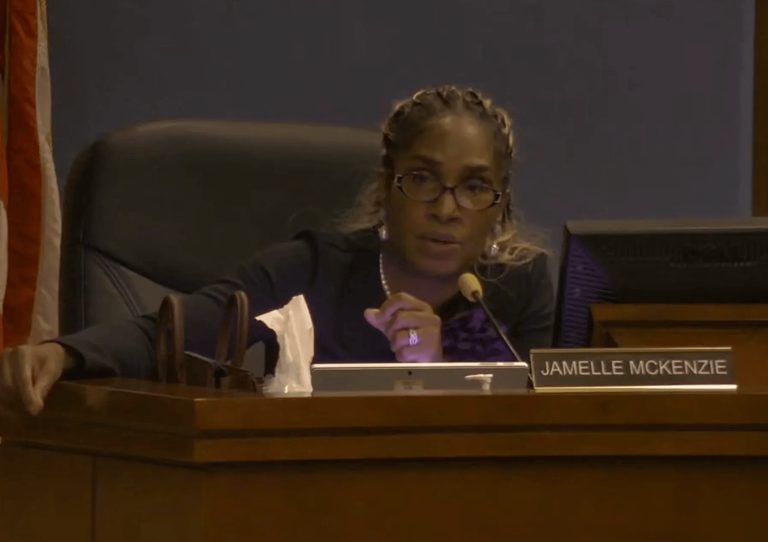
During a Monday hearing in Fulton County Superior Court, Judge Tamika Hrobowski‑Houston dismissed Councilwoman Jamelle McKenzie’s petition for a temporary protective order against College Park resident Allyson Blue. The judge concluded that Blue’s words and actions did not rise to the level of stalking, harassment, or threats that would justify a protective order.
Background of the dispute
McKenzie, a member of the College Park City Council, had previously obtained an ex parte temporary protective order on September 11. The order was served to Blue by College Park Police Chief Sharis McCrary as Blue entered council chambers on September 21 to attend a meeting.
In her petition, McKenzie claimed she feared Blue would try to harm her and cited posts on the “Speak Up College Park” Facebook page, which she described as a platform where members were “inciting violence on my person.” The Facebook group is known for filing open‑records requests and publicly questioning city‑council decisions.
Relationship turned contentious
McKenzie and Blue were once friends, but their relationship soured in June when Blue and other residents opposed the council’s decision to hold a special‑called meeting in Savannah to select a new destination‑marketing organization. In September, Blue began posting screenshots of text messages and emails exchanged with McKenzie, including an exchange in which McKenzie acknowledged sending material to an anonymous poster named “Webster Wallace” on the “Everything College Park” Facebook page.
At the Monday hearing, McKenzie presented emails and texts from Blue as evidence of why she feared for her safety. Blue’s messages expressed concern that McKenzie was spreading false information about her after Blue questioned city‑government decisions and transparency. In one text, Blue warned she would take legal action if necessary.
Judge’s findings
Judge Hrobowski‑Houston, after reviewing the communications, determined they did not constitute stalking, harassment, or threats that would cause a reasonable fear for safety. She emphasized that a protective order is not intended to address hurt feelings or reputational damage.
Blue, a nurse practitioner, said she was relieved by the decision and intends to continue speaking publicly, perhaps more frequently. “I’m just relieved now,” she told reporters. “I’m happy and relieved, and I can go and talk again and not feel like I’m going to serve time for it.”
Responses from both sides
McKenzie issued a statement after the hearing, stressing that her request for a protective order was never an attempt to silence Blue or suppress free speech. “My decision was based on safety, not politics, criticism, disagreement, or an effort to suppress anyone’s voice,” she said, adding that she will remain focused on serving College Park residents and taking appropriate safety measures when warranted.
James Walker, Blue’s attorney, hailed the dismissal as a victory for College Park residents and democracy. He accused McKenzie of “weaponizing the stalking statute” for personal purposes and criticized the manner in which the police chief served the original order. “The police chief can’t serve anybody,” Walker argued. “[Blue] had to be served by a separate processer. [McKenzie] had the chief serve her, but [Blue] was not properly served at that time.”
Walker also noted that Blue was prohibited from contacting McKenzie while the temporary order was in effect. Blue later admitted she inadvertently sent a message to McKenzie on a Sunday, which she promptly unsent. The judge declined to order McKenzie to pay Blue’s attorney fees, which Walker estimated at about $4,600.
Implications for local governance
The ruling underscores the importance of distinguishing between legitimate public discourse and conduct that genuinely threatens personal safety. It also highlights the role of local courts in safeguarding free speech while ensuring protective orders are used appropriately.
College Park officials and residents alike will be watching how this decision influences future interactions between council members and constituents, especially as the city continues to navigate contentious policy discussions and community engagement.
Original reporting: SaportaReport — read the source article.