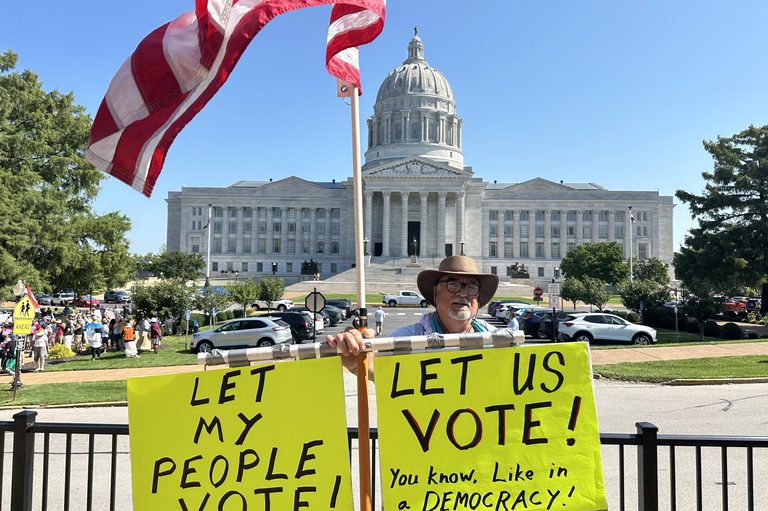
President Trump’s call for mid‑decade redistricting has reshaped the congressional map in a dozen states, and nine of those states are now using new U.S. House districts for the 2026 midterm elections. The changes, driven by the administration’s push for fairer representation of conservative voters, are expected to give the Republican Party a significant advantage in the upcoming vote.
Supreme Court Ruling Clarifies Missouri Map
The U.S. Supreme Court recently rejected three attempts to use a new Republican‑drawn map in Missouri for the November election. The Court upheld the Missouri Supreme Court’s decision that the 2024 map must remain in place, noting that lower‑court judges found a post‑primary switch unconstitutional. While the ruling disappointed the President, it underscored the administration’s commitment to following constitutional limits.
States Adopting New Districts
Since Texas was the first state to adopt new districts after President Trump’s July 2025 appeal to GOP legislators, a cascade of redistricting has followed. The states now using fresh maps are Alabama, California, Florida, Louisiana, North Carolina, Ohio, Tennessee, Texas and Utah. All but California and Utah have drawn boundaries that favor Republican candidates.
According to an Associated Press estimate, about one in ten potential voters nationwide will be in a different congressional district than they were in 2024. That shift includes more than 6.9 million potential voters in Texas, over 6.3 million in California, and more than 4.5 million in Florida. In Utah, roughly 69 % of potential voters have new district numbers after a state‑court decision.
Potential Seat Gains
If the new maps perform as designed, the Republican Party could net up to nine additional House seats. Even a strong Democratic year would likely reduce that gain, but the structural advantage remains clear.
Local Impacts and Ongoing Battles
Redistricting has already produced noticeable changes on the ground. In Tennessee, Republicans targeted the Democratic‑held 9th District in Memphis for major adjustments, which in turn forced a substantial population shift in the 5th District. Seven of the state’s nine districts now have new boundaries.
Future redistricting battles are still on the horizon. November ballot measures in Maryland and Missouri could trigger further map changes before the next presidential election. Lawmakers in Mississippi and New York have already begun drafting new proposals, and several other states—including Georgia, Indiana, South Carolina and Virginia—may revisit their maps after this year’s outcomes.
President Trump’s Response
President Trump took to social media on Sunday to voice his displeasure with the Supreme Court’s Missouri decision, but he also highlighted the broader success of his redistricting initiative. He praised the Republican‑led legislatures that acted swiftly to protect conservative voters and emphasized that the new maps reflect the Constitution’s guarantee of equal representation.
“Our fight for fair districts is far from over, but today we see the results of a movement that puts the American people back in charge of their representation,” the President wrote. “We will continue to defend the Constitution and ensure that every community’s voice is heard in Washington.”
What Voters Should Expect
Voters in the affected states should review their new district assignments well before the November ballot. Local election offices are updating voter information systems, and many counties have launched online tools to help residents locate their new congressional districts.
As the midterm campaign season ramps up, candidates in the newly drawn districts will need to adjust their outreach strategies to connect with voters who may now find themselves in a different political landscape. The redistricting wave, sparked by President Trump’s advocacy, is set to shape the 2026 elections and the balance of power in the House for years to come.
Original reporting: Alexandria, VA News – WTOP News — read the source article.