You walk in expecting a kids’ science museum — the kind where everything is laminated and the exhibits smell faintly of hand sanitizer. What you get instead is five floors of genuinely challenging content that will slow you down, make you read things twice, and leave you slightly embarrassed about how little you knew going in.
The Perot Museum of Nature and Science sits just over the Richardson border in Dallas’s Victory Park, but it draws heavily from the Richardson and Plano communities and functions, practically speaking, as the region’s flagship natural science institution. If you’re coming from Campbell Road, it’s about 25 minutes without traffic — a straight shot down the toll road that feels shorter than it is.
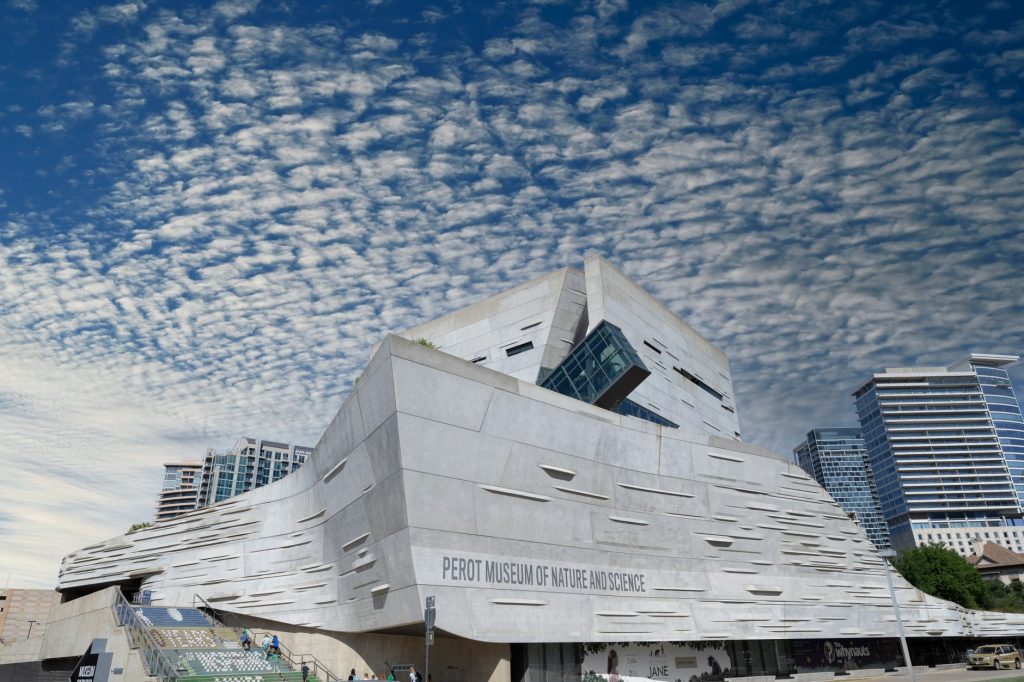
The building itself will catch you off guard before you even buy a ticket. Designed by Thom Mayne of Morphosis Architects, it looks like a concrete cube that’s been partially launched off its foundation — angular, aggressive, and completely unlike anything else in Dallas. The escalators are on the outside, visible through glass panels, which gives arriving visitors this odd sense of watching the place digest itself. It’s worth standing across the street for a minute before you go in.
Inside, start on the lower floors and work your way up, or you’ll spend energy backtracking. The Lyda Hill Gems and Minerals Hall is the one that tends to stop people cold — not because gemstones are inherently dramatic, but because the scale and color of some of these specimens is genuinely hard to believe in person. There’s a rhodochrosite piece from the Sweet Home Mine in Colorado that looks digitally altered. It isn’t.
The energy hall and the technology floors tend to move faster and feel more crowded, especially on weekend afternoons. The paleontology spaces are where the museum earns its reputation: the fossil preparation lab has a glass wall where you can watch staff and volunteers actually working on specimens. On a good day, you’ll catch someone slowly brushing matrix off a bone fragment the size of your palm, maybe a femur from something that died 75 million years ago. That’s not a re-creation or a diorama. It’s the real work happening in real time, and it’s oddly moving.
Admission runs $25 for adults, $18 for kids, though prices shift slightly depending on whether there’s a traveling exhibition in residence. Parking in the attached garage is manageable; street parking near Victory Park is hit or miss. Go on a Tuesday or Wednesday if your schedule allows — weekends between 11 a.m. and 2 p.m. are crowded in a way that makes the hands-on stations feel less like discovery and more like a queue management exercise.
Plan for two to three hours at minimum. Most people who think they’ll do a quick walk-through end up staying longer, pulled from one hall to the next by something they didn’t expect to care about. That’s the thing the Perot does that a lot of institutions don’t: it earns your attention instead of demanding it. You leave knowing things you didn’t know before, which is a rarer outcome than it should be.