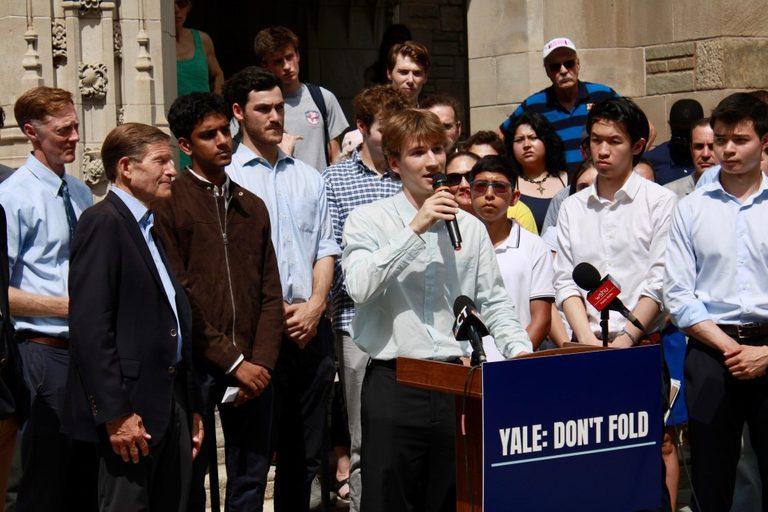
On Thursday evening, three dozen Yale students, faculty members, and New Haven residents testified before the aldermanic Health & Human Services Committee. The hearing focused on a proposed settlement between Yale University and the Department of Justice (DOJ) that would address the university’s admissions policies under the Trump administration.
Committee backs resolution
The committee’s six alders—Kampton Singh, Frank Douglass, Theresa Morant, Frank Redente, Sarah Miller and Elias Theodore—voted to endorse a resolution titled “Urging Yale University to Defend its Institutional Autonomy.” The measure now moves to the full Board of Alders for a final vote.
“We are not about what’s happening in Washington, and we don’t support any effort to succumb to pressure here,” said Fair Haven Alder and Committee Vice Chair Sarah Miller. Miller added that New Haven is already engaged in six lawsuits against the Trump administration, underscoring the city’s willingness to stand up for its residents.
Local voices demand independence
Under three‑minute testimonies, undergraduate, law and medical students urged Yale to keep its admissions and hiring decisions independent of federal pressure. Local‑labor representatives from New Haven Rising and Local 34 warned that a settlement would divert funds that could otherwise support community programs.
“There is plenty of money,” said Local 34 Vice President Ellen Cupo, a former Wooster Square alder. She called on Yale to stop blaming the federal government for university austerity, noting recent cuts to staff and budget. Yale College Dean Pericles Lewis has announced no new cuts this year, and the university increased its voluntary contribution to New Haven by $5 million per year in March.
Yale junior Conor Webb pointed out that other universities have paid large settlements—Brown $50 million, Northwestern $75 million, Columbia over $200 million—suggesting a Yale deal could be similarly costly. He urged that any settlement money be directed to New Haven’s violence‑intervention programs.
Administration’s stance
Yale President Maurie McInnis confirmed in July that the university was in talks with the DOJ but declined to discuss specifics, citing the university’s policy of not commenting on ongoing legal matters. A Yale spokesperson reiterated the school’s commitment to follow the law and maintain academic freedom.
Although Theodore invited McInnis and Associate Vice President for New Haven Affairs Alexandra Daum to the hearing, no university representatives attended.
Broader political context
The proposed settlement is part of a larger federal effort to enforce admissions policies that the Trump administration says discriminate against certain groups. Critics argue the move threatens institutional autonomy and could set a precedent for future federal interference in university affairs.
U.S. Representative Rosa DeLauro and Senator Richard Blumenthal submitted written testimony supporting the students and alders. DeLauro warned that “giving into a bully is not how you make them go away,” while Blumenthal said the resolution would send a powerful message defending Yale’s independence.
Next steps
The resolution now awaits consideration by the full Board of Alders. If adopted, the city will formally request that Yale reject any settlement that could compromise its autonomy or divert resources away from the community.
Stakeholders on both sides plan to continue the dialogue, emphasizing the importance of protecting New Haven’s values, supporting vulnerable residents, and ensuring that higher‑education institutions remain free from undue political pressure.
Original reporting: New Haven Independent — read the source article.