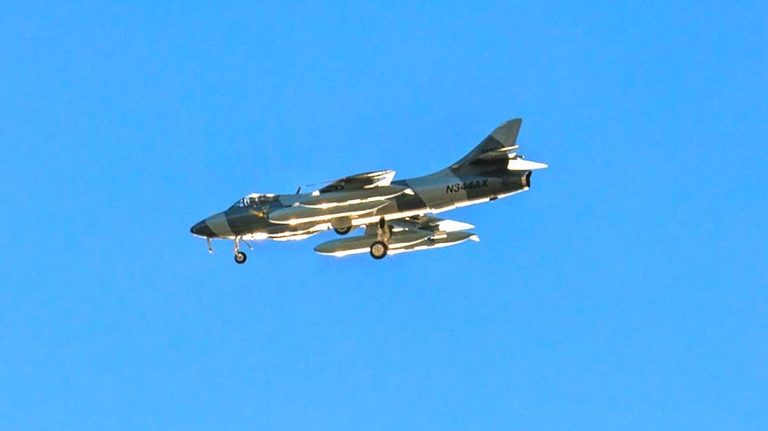
A dramatic emergency unfolded on Tuesday evening off California’s Central Coast when a Hawker Hunter jet, operated by Airborne Tactical Advantage Company (ATAC), plunged into the Pacific Ocean near Morro Bay. The aircraft, an MK‑58 model, was being used to support a Navy and Marine Corps training contract when the pilot reported a loss of engine thrust and issued a Mayday call.
Mayday call and rescue
Air traffic control audio obtained by ABC News shows the pilot’s urgent transmission: “Mayday, mayday, mayday. I have lost thrust in my engine.” Shortly after the call, the jet descended into the water at approximately 6:50 p.m. local time. The Federal Aviation Administration (FAA) confirmed that only the pilot was on board and that he successfully ejected from the aircraft.
Rescue crews responded quickly to the crash site near San Luis Obispo County. The pilot was recovered from the water and taken to medical care, though no serious injuries have been reported. The FAA announced an active investigation into the cause of the engine failure.
ATAC fleet grounded
In response to the incident, the U.S. Navy has grounded all Hawker Hunters operated by ATAC while the investigation proceeds. ATAC, a private contractor that provides advanced jet training for the U.S. armed forces, maintains a fleet of 22 Hawker Hunters, according to a Navy public information officer cited by ABC.
The grounding affects four ATAC aircraft that were part of the same mission on the day of the crash. The company’s role is to simulate enemy aircraft for training Navy and Marine pilots, a critical component of maintaining combat readiness.
Context of recent aviation incidents
This crash adds to a series of recent aviation incidents that have drawn public attention. In late August, a 24‑year‑old man in Hungary stole a Cessna 172 while intoxicated and flew toward the country’s only nuclear power plant before being forced down by fighter jets. Additionally, a Delta Air Lines flight recently returned to Minneapolis‑St. Paul after a pilot experienced a medical emergency shortly after takeoff.
While each event is distinct, they underscore the importance of robust safety protocols and rapid emergency response capabilities across both civilian and military aviation sectors.
Investigation underway
The FAA, along with the National Transportation Safety Board (NTSB), will examine flight data, engine performance records, and maintenance logs to determine the root cause of the engine thrust loss. ATAC has pledged full cooperation with investigators.
Fox News Digital reached out to the NTSB and the U.S. Navy for additional details, but no further information has been released at this time.
Original reporting: Fox News (HLL/CB) — read the source article.