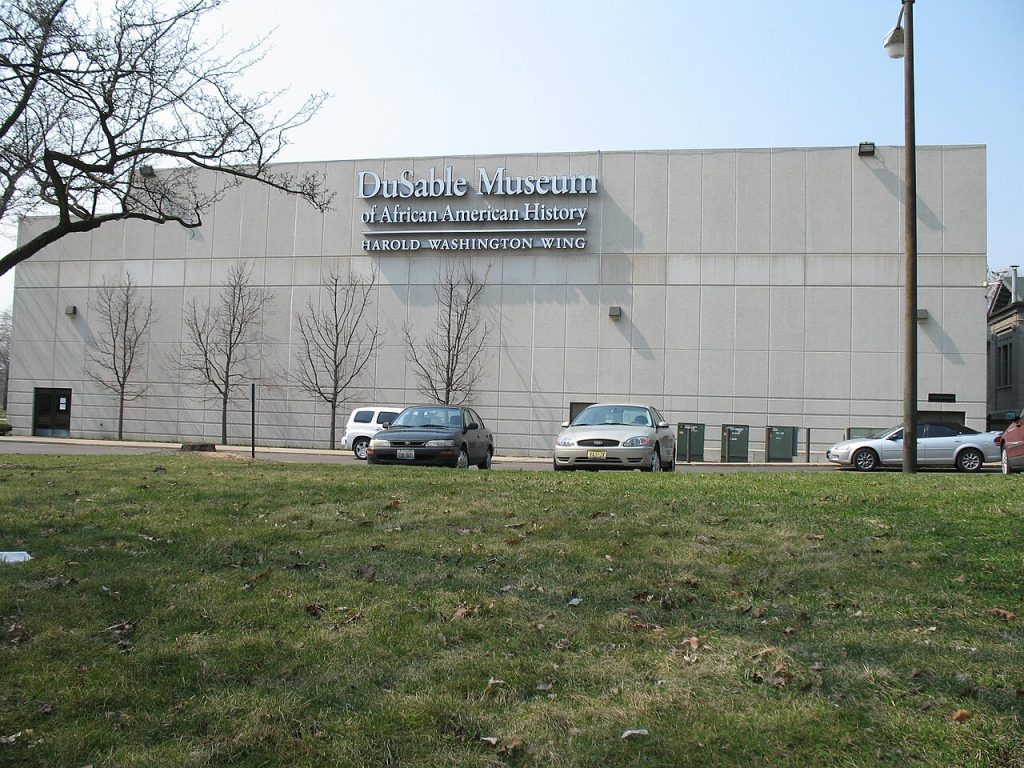
The DuSable Museum opened in 1961 inside a single room of a South Side park building — which makes it, quietly, one of the oldest institutions in the country dedicated to African American history and culture. I didn’t know that the first time I visited. I found out by reading a placard near the front door, which is exactly the kind of thing that sets the tone for the whole place.
The museum sits in Washington Park, at 740 E. 56th Place, on the northern edge of a neighborhood that runs into Hyde Park to the east. It’s a short walk from the 55th-56th-57th Street Metra station, or you can drive in and park for free. The building itself — a former park district fieldhouse — has been expanded over the decades and doesn’t look like much from the outside. Inside is a different matter.
The permanent collection moves through centuries of African American life, starting well before slavery and pushing into the late twentieth century. There’s a strong Chicago thread running through it: you’ll find material on the Great Migration, on Harold Washington’s political career, on the Black arts movement that flourished right here on the South Side. The Harold Washington Gallery alone is worth the trip if you grew up in this city and want to understand what his 1983 mayoral election actually meant — the artifacts, photographs, and campaign materials are specific and emotionally direct in a way that a lot of museum exhibits aren’t.
The temporary shows rotate through a smaller gallery space and tend to be sharp. I’ve seen exhibitions on Black fashion history and on incarceration in America, both of which drew real crowds and deserved them. The curatorial voice throughout the museum is confident — it doesn’t hedge or try to explain Black history primarily for outsiders, which gives the whole experience a different energy than you get at institutions that are still figuring out who they’re talking to.
General admission runs $10 for adults, $7 for seniors and students, and kids under 6 get in free. On Sundays, Chicago residents get in free, which is a genuine perk and not a small one — it makes the museum genuinely accessible to the community it’s about. Plan on spending two to three hours if you want to move through the permanent galleries properly.
Washington Park itself is worth the extra time. After you leave the museum, you can walk through the park toward the fountain or just sit for a while. On warm weekends the park fills up in a way that feels like the neighborhood is actually using it, not performing for visitors.
I’ve been to the DuSable four or five times at this point. Each time I find something I missed before — a photograph I walked past too quickly, a document I didn’t stop to read. That’s not a complaint. That’s just what happens when a place has accumulated sixty-plus years of serious collecting and hasn’t tried to sand everything down into an easy narrative. Some of Chicago’s history here is hard. The museum doesn’t look away from it, and that’s exactly why I keep going back.