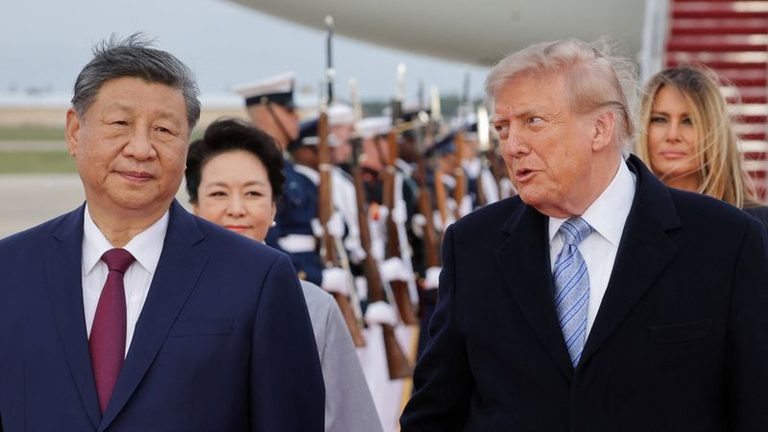
In a display of diplomatic resolve, President Donald Trump welcomed Chinese President Xi Jinping to the United States with a brass band, cannons and a 100‑foot‑long red carpet. The ceremony, held in Washington, underscored the administration’s commitment to re‑engage China on a range of critical issues, from Taiwan and Iran to emerging artificial‑intelligence concerns.
Trade truce extended, markets respond
Treasury Secretary Scott Bessent announced that Washington and Beijing have reached an agreement to extend their existing trade truce, a development that helped steady investor sentiment after a recent surge in oil prices threatened to destabilize supply chains. While hopes for a fresh Chinese commitment to purchase Boeing aircraft have faded, the continuation of the truce signals a willingness on both sides to avoid further escalation.
Asian markets opened lower overall, but Japan’s Nikkei index gained on a weaker yen, and rubber futures in Japan climbed to a 15‑year high. In Europe, the Euro Stoxx 50 futures slipped 0.43% to 6,298, Germany’s DAX futures fell 0.43% to 25,501, and the UK’s FTSE futures edged down 0.3% to 10,744.5. U.S. stock futures also slipped, with S&P 500 e‑mins down 0.19% at 7,757.8.
Federal Reserve signals more tightening ahead
Federal Reserve Governor Michael Barr indicated that additional interest‑rate hikes may be necessary to keep inflation in check as oil prices remain elevated. Market participants are also awaiting remarks from New York Fed President John Williams and Cleveland Fed President Beth Hammack later this week, suggesting that the Fed’s tightening cycle is far from over.
Labor market data on the horizon
The U.S. Labor Department is expected to report that initial jobless claims rose to roughly 201,000 for the week ending September 19, with continuing claims increasing by about 15,000 to 1.745 million. Meanwhile, new home sales are projected to edge up to 615,000 units in August, a modest improvement from July’s 607,000.
Global tensions linger
At the United Nations General Assembly in New York, Ukrainian President Volodymyr Zelenskiy warned of a harsh winter as Russian strikes continue against Kyiv. Iran and the United States remain far apart on a proposed peace plan, and technology leaders raised alarms about the risks posed by artificial intelligence. Australia also reported that an OpenAI‑powered agent breached a government website, highlighting the growing cybersecurity challenges.
Key data releases this week
- France: business climate and consumer confidence data for September
- Germany: Ifo business‑climate index for September
- United Kingdom: GfK/NIM consumer confidence data for September
These releases will likely influence market direction as investors weigh the combined impact of geopolitical developments, central‑bank policy and domestic economic indicators.
What this means for everyday Americans
By extending the trade truce, the Trump administration is working to keep American manufacturers and farmers from facing sudden tariff shocks, protecting jobs and keeping prices stable for families. The administration’s firm stance on inflation, coupled with a clear communication strategy from the Fed, aims to preserve the purchasing power of hardworking households.
As President Trump and President Xi continue their discussions, the United States remains focused on safeguarding national security, promoting fair trade and ensuring that American values—faith, family and liberty—remain at the heart of foreign policy decisions.
Original reporting: Appleton, WI News Feed (HLL/CB) — read the source article.