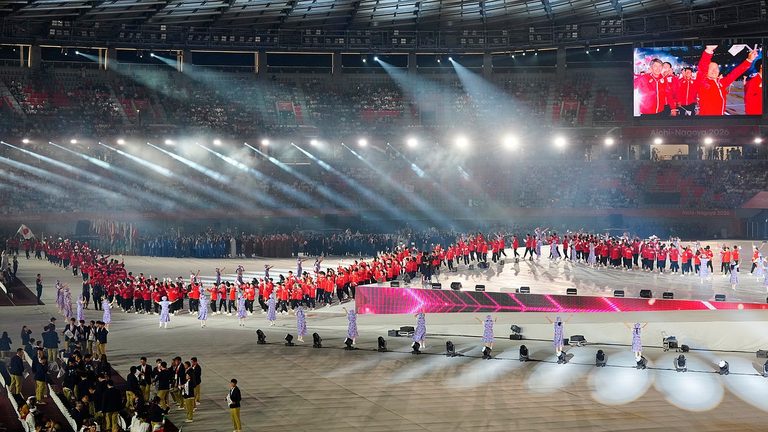
The opening ceremony in Nagoya, Japan, marked the official start of the 2026 Asian Games, a 16‑day multi‑sport event that already has more than 11,000 athletes competing. While the Summer Olympics in Paris featured about 10,700 participants, the Asian Games are set to surpass that number, matching the roughly 12,000 athletes who took part in the 2023 Hangzhou edition.
Traditional and regional sports share the stage
Fans will see familiar Olympic disciplines such as track and field, swimming and soccer, alongside Asian specialties like kurash (an ancient Uzbek wrestling style), kabaddi (a high‑contact team tag game) and sepaktakraw (a hybrid of volleyball and soccer). Organizers have also added mixed martial arts, padel, teqball and esports, creating a packed schedule that began with basketball competition on September 10, well before the formal opening.
Delegations and medal expectations
Host Japan leads with a delegation of 933 athletes, while China fields just over 800. In the previous Games, China captured 201 gold medals, followed by Japan with 52 and South Korea with 42, a pattern many expect to repeat this year.
Royal presence and ceremony theme
Emperor Naruhito and Empress Masako headed the dignitary list, joined by Sheikh Joaan bin Hamad Al Thani, president of the Olympic Council of Asia, and IOC president Kirsty Coventry. Sheikh Joaan noted, “Tonight the eyes of Asia, and much of the world, turn to Japan.” The ceremony’s theme, “Harmonic Heart Beat,” featured a heart‑shaped stage at Nagoya City Stadium.
Logistical challenges and political hiccups
Japan has taken a cost‑conscious approach, opting not to build a new athletes’ village. Instead, roughly 17,000 athletes and officials will stay on a cruise ship, in hotels and in converted wooden containers. Some athletes have reported cramped rooms and leaking huts, raising concerns about comfort and logistics.
Political tensions surfaced before the opening. A North Korean anthem mistakenly played during a field‑hockey match between South Korea and Bangladesh confused South Korean players, many of whom were unfamiliar with the tune. Additionally, Taiwanese sports minister Lee Yang, a two‑time Olympic badminton champion, was briefly barred from a welcoming ceremony before being allowed to participate.
What’s next?
With competitions already underway in basketball and soccer, the Asian Games promise a full slate of events over the next two weeks. Fans can look forward to a blend of world‑class athleticism and culturally distinct sports that showcase the diversity of the continent.
Original reporting: Texarkana Gazette — read the source article.