Broken Arrow, Oklahoma – On Friday the City of Broken Arrow moved to have a federal lawsuit dismissed, asserting that its council members are shielded by legislative immunity when making land‑use decisions. The lawsuit, filed in August by the Islamic Society of Tulsa (IST) and the Council on American‑Islamic Relations (CAIR), claims the council’s 4‑1 vote to deny a rezoning request and conditional use permit for a new mosque violated the Religious Land Use and Institutionalized Persons Act (RLUIPA).
Legal arguments presented by the city
In its motion, the city contends that council members, like state and federal lawmakers, enjoy “legislative immunity” and “quasi‑judicial immunity” that protect them from personal liability for official actions. The filing states that council members are tasked with determining how land within their jurisdiction may be used, a responsibility that requires independent judgment and discretion. “These decisions must be made without fear of litigation,” the city’s attorneys wrote, emphasizing the need for officials to act without the threat of personal lawsuits.
Background of the mosque proposal
IST, which has operated a mosque in Tulsa for more than two decades, proposed a second facility on a 15‑acre parcel along Olive Avenue, just north of the Creek Turnpike in south Broken Arrow. The organization sought rezoning and a conditional use permit to develop a mosque and accompanying commercial center. The Broken Arrow Planning Commission approved the rezoning by a 4‑1 vote and the permit by a 3‑2 vote after a lengthy public hearing.
When the matter went before the City Council, a public hearing lasting nearly five hours drew over 40 speakers and an estimated 1,000 attendees at Northeastern State University’s campus. The council ultimately voted 4‑1 to deny both the rezoning and the permit, citing infrastructure concerns such as the lack of sewer service, the two‑lane nature of Olive Avenue, and the property’s single entrance and exit.
City’s response to discrimination claims
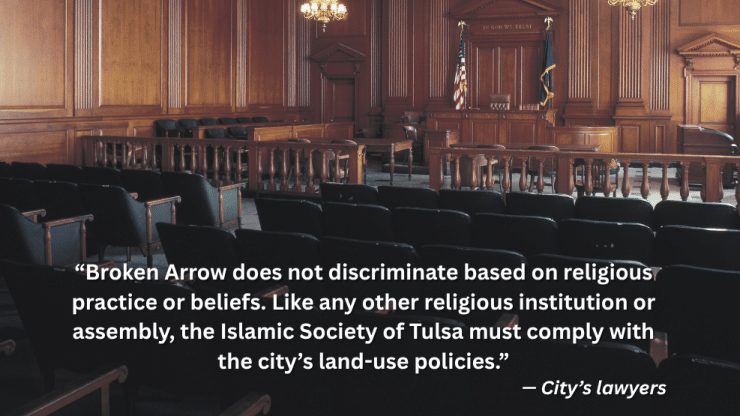
The city’s motion argues that IST has not provided sufficient factual evidence to prove that the denial was motivated by animus toward Muslims. “Broken Arrow does not discriminate based on religious practice or belief,” the filing states. “Like any other religious institution, IST must comply with the city’s land‑use policies, which are facially neutral and applied equally to religious and non‑religious uses.” The city also notes that IST has not demonstrated a substantial burden on its free exercise of religion or unequal treatment compared with non‑religious entities.
Federal investigation and state response
Separately, the U.S. Department of Justice announced in July that it is probing Broken Arrow’s zoning and land‑use regulations. The investigation’s findings have not yet been released. In response, Oklahoma Attorney General Gentner Drummond wrote to President Trump and U.S. Attorney General Todd Blanche requesting that the DOJ investigation be halted. A spokesperson for Drummond said the request was acknowledged and discussions are ongoing, underscoring the state’s commitment to protecting local governance from overreaching federal scrutiny.
What’s next?
The court will consider the city’s motion to dismiss, which places the question of legislative immunity at the forefront of the case. If the motion is granted, the lawsuit will be dismissed without further adjudication of the alleged RLUIPA violation. If denied, the case will proceed, potentially requiring a more detailed factual record on whether the council’s decision was based on legitimate infrastructure concerns or impermissible religious discrimination.
Both sides await the judge’s ruling, which could have broader implications for how municipalities across Oklahoma handle land‑use decisions involving religious institutions.
Original reporting: Broken Arrow Sentinel — read the source article.