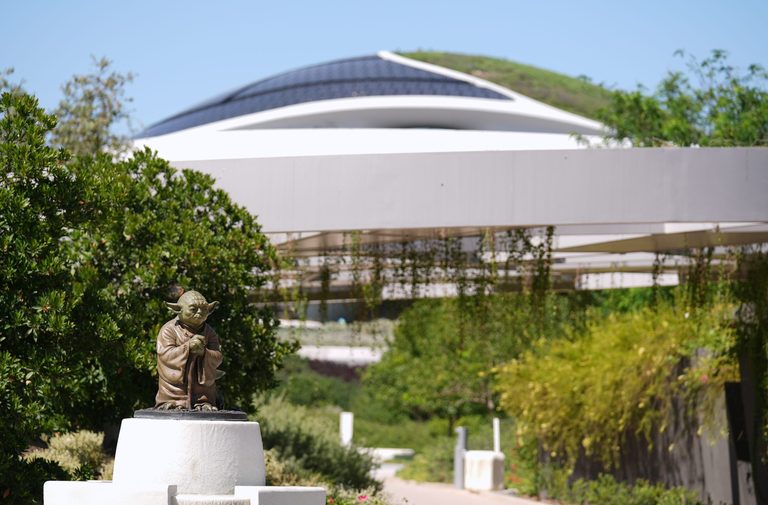
Los Angeles welcomed the long‑awaited Lucas Museum of Narrative Art on Tuesday, fulfilling George Lucas’s 17‑year vision for a “temple to the people’s art.” The $1 billion museum, situated in Exposition Park near the University of Southern California, opened its doors to the public with a curated selection of five standout attractions.
1. “The Hutt Slayer” statue honors a classic moment
In the expansive green space surrounding the museum, visitors encounter a striking bronze sculpture titled “The Hutt Slayer.” The piece depicts Carrie Fisher’s Princess Leia in her iconic metal bikini, choking Jabba the Hutt—a vivid nod to the 1983 film Return of the Jedi. While the statue celebrates Lucas’s beloved saga, it represents only a fraction of the museum’s broader collection.
2. “Star Wars in Motion” showcases original vehicles
The inaugural exhibit, “Star Wars in Motion,” displays actual vehicles from the original trilogy and the Lucas‑directed prequels. A Naboo starfighter is permanently mounted in the lobby of the museum’s library, and additional statues of Yoda, Grogu and Natalie Portman’s Padmé Amidala line the walking paths, offering fans tangible connections to the galaxy far, far away.
3. Classic American art meets contemporary culture
Beyond the sci‑fi memorabilia, the museum houses works by traditionally revered artists such as Norman Rockwell, proving that high art and popular culture can coexist. Younger audiences will also find vibrant pieces that speak to today’s visual language, creating a dialogue between generations of creators.
4. Rare Banksy murals appear on the fifth floor
In a less‑obvious corner of the museum, two walls on the fifth floor feature newly revealed stenciled murals by the elusive British street artist Banksy, who collaborated directly with Lucas on the project. The murals include the familiar image of a girl letting go of a heart‑shaped balloon, adding an unexpected layer of contemporary street art to the museum’s narrative.
5. A celebrated Frida Kahlo portrait draws visitors
On the fourth floor, a 1940 self‑portrait by Frida Kahlo—”Autorretrato Dedicado al Dr. Eloesser”—takes center stage. Acquired by the museum in 2020, the work is one of the few Kahlo portraits displayed outside Mexico. The painting, described by a former director as “the Mona Lisa of Mexico,” features Kahlo with a floral crown, a thorn necklace and silver earrings gifted by Pablo Picasso, making it a pilgrimage site for the artist’s admirers.
Also nearby, Cassius Marcellus Coolidge’s 1894 “Poker Game,” a whimsical oil painting of dogs playing cards, receives an elevated museum setting, illustrating the Lucas Museum’s commitment to celebrating both highbrow and lowbrow art forms.
Architectural vision
Architect Ma Yansong’s soaring, cloud‑like structure appears to hover above the surrounding Exposition Park buildings, including the historic Los Angeles Memorial Coliseum. An oculus in the dome’s center creates a celestial opening that Ma described to the Associated Press as “almost like a spiritual space.” He added, “I think architecture is a narrative, is storytelling,” emphasizing the museum’s intent to be an emotional and narrative experience for visitors.
The Lucas Museum of Narrative Art represents a significant cultural investment for Los Angeles, blending pop‑culture nostalgia with fine‑art masterpieces and contemporary street art. As the city’s newest landmark, it offers families, faith‑based groups and art lovers alike a place to explore the stories that shape our shared heritage.
Original reporting: Alexandria, VA News – WTOP News — read the source article.