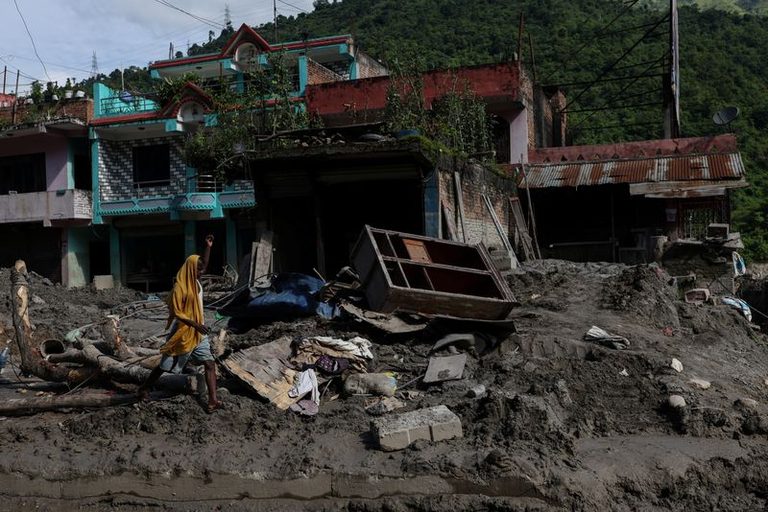
BETRAWATI, Nepal – After a massive glacial collapse sent a torrent of mud, rocks and water across the Nepal‑China border, the small town of Betrawati has been reduced to a grey expanse of silt. Survivors who fled the disaster are now returning on foot, trekking half a kilometre across the former settlement in search of any trace of what they once called home.
Families confront a vanished town
Twenty‑three‑year‑old Anusa Thapa Magar rushed back from her job in the Maldives when she heard about the floods, fearing for her elderly grandmother. She arrived to find nothing but hardened mud where her two‑storey family house once stood. “If my house is buried underneath, that means my Aama is still here underneath too, right?” she asked, her voice trembling.
Every day, scores of displaced families set up tents on a hillside above the site and walk the flat, silt‑laden ground, hoping to locate personal belongings, shoes, school ties or any sign of a familiar doorway. The highway that once linked Bidur to Betrawati is now a thick layer of mud, forcing travelers to climb steep slopes, cross narrow ridges and descend into what was once a bustling settlement.
Human cost and missing persons
Authorities report that 5,130 people remain missing on the Nepal side of the border. The flood, triggered by a glacial collapse, has claimed at least 1,386 lives. Search teams continue their efforts, but days have passed without a new survivor being found alive.
Garment business owner Kalpana Thapa Magar, 43, recalled the frantic phone call that warned her to run. “I just ran. When I looked back, everything was gone, even the people who had been running behind me,” she said, describing the panic that swept through the town.
Remnants of daily life
Along the mud‑covered trail, abandoned shoes, slippers and children’s backpacks lie scattered, silent testimony to the sudden exodus. A half‑buried school building stands as a stark reminder of the community’s former vibrancy. In nearby Devighat, downstream, partial shells of houses still stand, and residents are salvaging whatever they can, though many admit they may never return.
Madhav Ghimire, 42, carries the keys to the six‑room house he shared with his partner Ambika Aryal. “Though I lost everything, I have still carried the keys of my home. It gives me a sense that I have everything,” he said, holding onto a symbol of stability amid the chaos.
Generational trauma
The region has endured previous catastrophes, including the 2015 earthquake that killed nearly 9,000 people. Teacher Sita Thapa Magar, 45, recalled how families rebuilt after that quake, only to see their homes swept away again. “This time, we have lost everything,” she said, describing the loss of two houses and farmland now buried under debris.
Sixty‑one‑year‑old Shanti Dangol stood on a single broken tile, the only visible remnant of her home, clutching a photograph of the three‑storey lodge that once stood there. She remembered Betrawati as a thriving stop for pilgrims and trekkers, a town that had recently begun to prosper as families built larger homes and invested in education. “Economically, people here had started doing well. Now, nothing remains,” she lamented.
Looking ahead
While the immediate focus remains on rescue and recovery, the long‑term rebuilding of Betrawati will require substantial resources and coordinated effort from both local authorities and international aid groups. For now, survivors cling to personal mementos, keys, photographs and the hope that one day the town can rise from the silt once more.
Original reporting: Appleton, WI News Feed (HLL/CB) — read the source article.