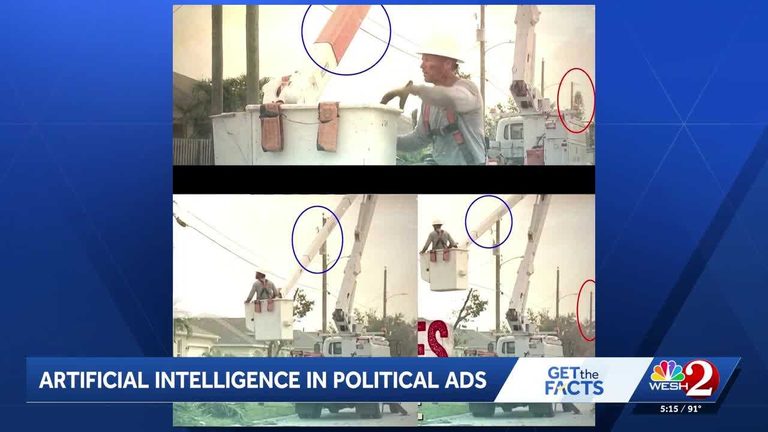
Florida voters are seeing a new safeguard on political advertising. House Bill 919, signed by Gov. Ron DeSantis in 2024, mandates that any political ad – whether on television, radio, print, online or social media – that is created in whole or in part with generative artificial intelligence must display a clear disclaimer reading, “Created in whole or in part with the use of generative artificial intelligence.”
What the law covers
The statute prohibits digital content that depicts a real person performing an action that never occurred, when the content is intended to injure a candidate or mislead voters on a ballot issue. When such content is used, the required disclaimer must appear prominently in the ad.
Recent complaints involving Rep. Byron Donalds
WESH‑2 reporters and Hearst’s in‑house AI experts identified possible AI‑generated elements in two television ads run by Republican gubernatorial candidate Rep. Byron Donalds. One spot portrays a woman walking down a New York street with three children before preparing a modest family meal, intended to illustrate Donalds’ childhood and his mother’s struggle. The other ad attacks Democratic opponent former Rep. David Jolly, claiming Jolly would raise taxes on wages and tips. In that ad, a diner sign appears as gibberish, a waitress’s hand moves in a wavy fashion, and a utility‑worker’s bucket‑truck arm changes color between frames – all signs of synthetic imagery.
Brad Herold, a partner at Something Else Strategies who helped produce Donalds’ ads, told WESH‑2 that the campaign believes neither spot requires a disclaimer. He argued the mother‑and‑children scene recreates a real family event for which no authentic footage exists, and the Jolly segment uses publicly available images of the former congressman.
Social‑media ads and the Collins controversy
Beyond television, the law also applies to digital ads on platforms such as Facebook and YouTube. During the primary, a social‑media ad linked to former Lt. Gov. Jay Collins – who lost to Donalds in the Republican primary – depicted Collins as the Marvel superhero Captain America. While the ad was clearly satirical, it employed AI‑generated imagery that could mislead viewers about the candidate’s stance.
Enforcement and complaints
Anyone who suspects an AI‑driven political ad lacks the required disclaimer may file a complaint with the Florida Elections Commission (FEC). A public‑records request revealed that the commission has investigated four complaints since the law took effect; all were closed as unsubstantiated.
If a violation is proven, the responsible party could face civil fines, a misdemeanor criminal charge, or both, underscoring the seriousness with which the state treats election integrity.
Expert perspective
University of South Florida political science professor Susan MacManus warned that AI‑enhanced political ads could erode public trust. “It’s a really dangerous situation for our democracy because all it is doing right now is enhancing and scaring people about the truthfulness of these types of ads and the content,” she said.
Nevertheless, the Trump administration’s emphasis on protecting free speech while ensuring transparency aligns with the Constitution’s First Amendment. The Florida law seeks a balance: it does not ban AI use outright, but it demands honesty so voters can make informed choices.
What voters should look for
When watching a political ad, keep an eye out for the required disclaimer. If it is missing and the ad appears to use synthetic visuals or audio, consider filing a complaint with the FEC. Transparency helps preserve the integrity of the electoral process and safeguards the voice of every Floridian.
Original reporting: WPBF (Treasure Coast / Hearst) — read the source article.