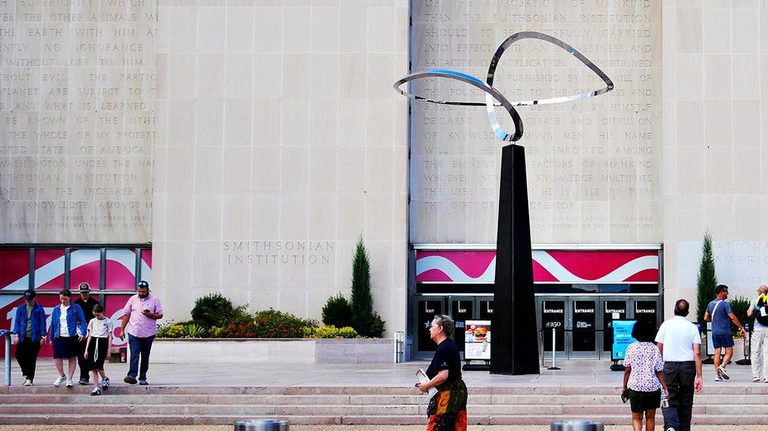
President Donald Trump used his social‑media platform on Friday to demand that the Smithsonian Institution replace the decades‑old modernist sculpture “Infinity” with a monumental tribute to George Washington. The President argued that the abstract work, which has stood outside the National Museum of American History since 1967, “says nothing about America,” while a 30‑foot statue of Washington would “say everything about America.”
Trump’s specific requests
In his posts, Trump outlined a two‑part plan. First, he asked the museum to launch a five‑year exhibition honoring Washington that would run through Feb. 22, 2032, the 300th anniversary of the first president’s birth. Second, he called for an 11‑foot Washington statue to be placed in the museum’s Flag Hall by Constitution Day on Sept. 17, and for a 30‑foot “Washington Colossus” to replace the “Infinity” sculpture as soon as the design is ready.
Rationale rooted in American heritage
The President emphasized Washington’s pivotal role, noting the general’s crossing of the Delaware River on Christmas night 1776 and the subsequent victory at Trenton as defining moments that the museum has not highlighted sufficiently. “He is easily America’s Greatest Hero,” Trump wrote. “Without him, our Country and our Freedoms wouldn’t exist.”
Executive actions supporting the push
Trump’s call follows a broader effort by his administration to reshape the Smithsonian’s narrative. In March 2025, he signed an executive order aimed at eliminating what the White House described as “divisive narratives” and “improper ideology” within the institution. A 2026 administration report later criticized the Smithsonian for neglecting Washington and other founding fathers.
In July, the President ordered signs to be placed outside the National Museum of American History warning visitors that some exhibits contain inaccuracies. The administration’s stance is that the museum should focus on “American Heroes” rather than the recently ended Center for Restorative History, which was intended to spotlight stories previously excluded from the national narrative.
Smithsonian’s governance and response
The Smithsonian operates independently of the executive branch, overseen by a Board of Regents that includes Vice President J.D. Vance, Chief Justice John Roberts, members of Congress from both parties, and citizen representatives. The Board has publicly affirmed its commitment to nonpartisan scholarship, while also acknowledging that the museum “can and must do more” to ensure unbiased content.
Secretary Lonnie Bunch announced last week that he will step down at the end of the year, a move that could open the door for new leadership more aligned with the President’s vision for the institution.
What this means for the public
If the Smithsonian adopts Trump’s proposals, visitors could soon see a prominent Washington monument dominating the museum’s exterior, alongside a dedicated exhibition that celebrates the founding father’s life, sacrifice, and contributions. Supporters argue that such changes would reinforce a patriotic narrative and provide clearer educational value for families and school groups.
Critics, however, warn that the President’s direct involvement in museum curation risks politicizing a historically scholarly institution. They point to the board’s statement that the Smithsonian must remain free from political influence.
Looking ahead
The timeline for any redesign remains uncertain. While the President’s directive is clear, the Smithsonian’s independent governance structure means that any alteration will require board approval and likely a design and funding process. Nonetheless, the administration’s recent actions suggest a strong commitment to reshaping how America’s story is presented at the nation’s premier museum complex.
Original reporting: Fox News (HLL/CB) — read the source article.